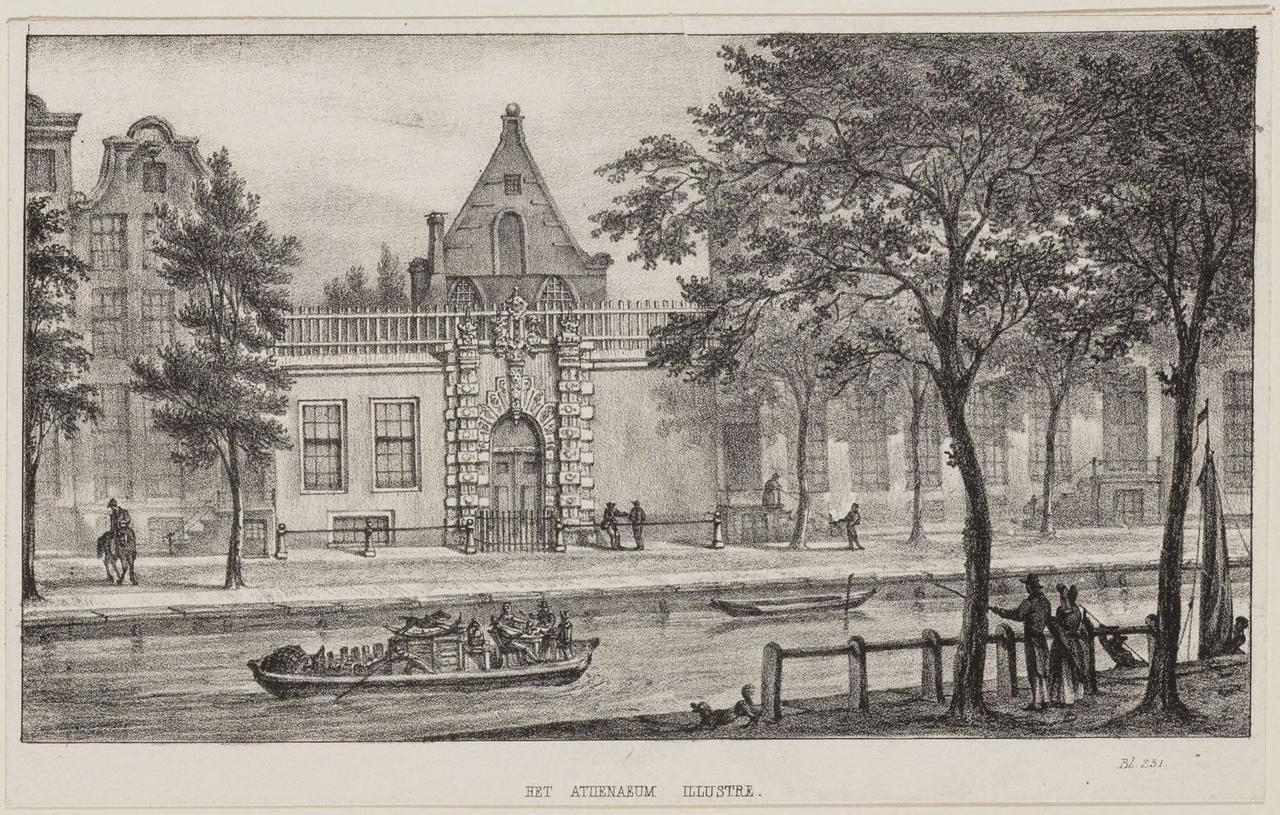
Athenaeum Illustre
The Athenaeum Illustre, the historical predecessor of the University of Amsterdam, was founded in January 1632. It was led by the prominent scholar Gerardus Vossius, with the support of the city of Amsterdam, despite considerable opposition. This opposition came particularly from the Protestant community affiliated with Leiden University, where Vossius had previously taught. Despite this resistance, the Athenaeum managed to open its doors, although it was not officially recognised as an educational institution at the time.
The city of Amsterdam, determined to attract Vossius, offered him an unprecedentedly high salary, higher than that of any other professor in the Netherlands. In its early years, the Athenaeum focused mainly on medical education, but classical subjects were soon added to the curriculum, taught by Vossius himself and the theologian Caspar Barlaeus.
The institution found its home at 231 Oudezijds Voorburgwal, in the former chapel of the Saint Agnes convent, also known as the Agietenkapel. This modest building soon became a popular meeting place; both students and interested visitors flocked to this location in large numbers to attend lectures.
Finally, after years of development and growth, the Athenaeum Illustre was officially recognised as an institution of higher learning in 1815. The crowning glory came in 1877, when the institution was granted university status and henceforth known as the University of Amsterdam.
Any feedback for this story?