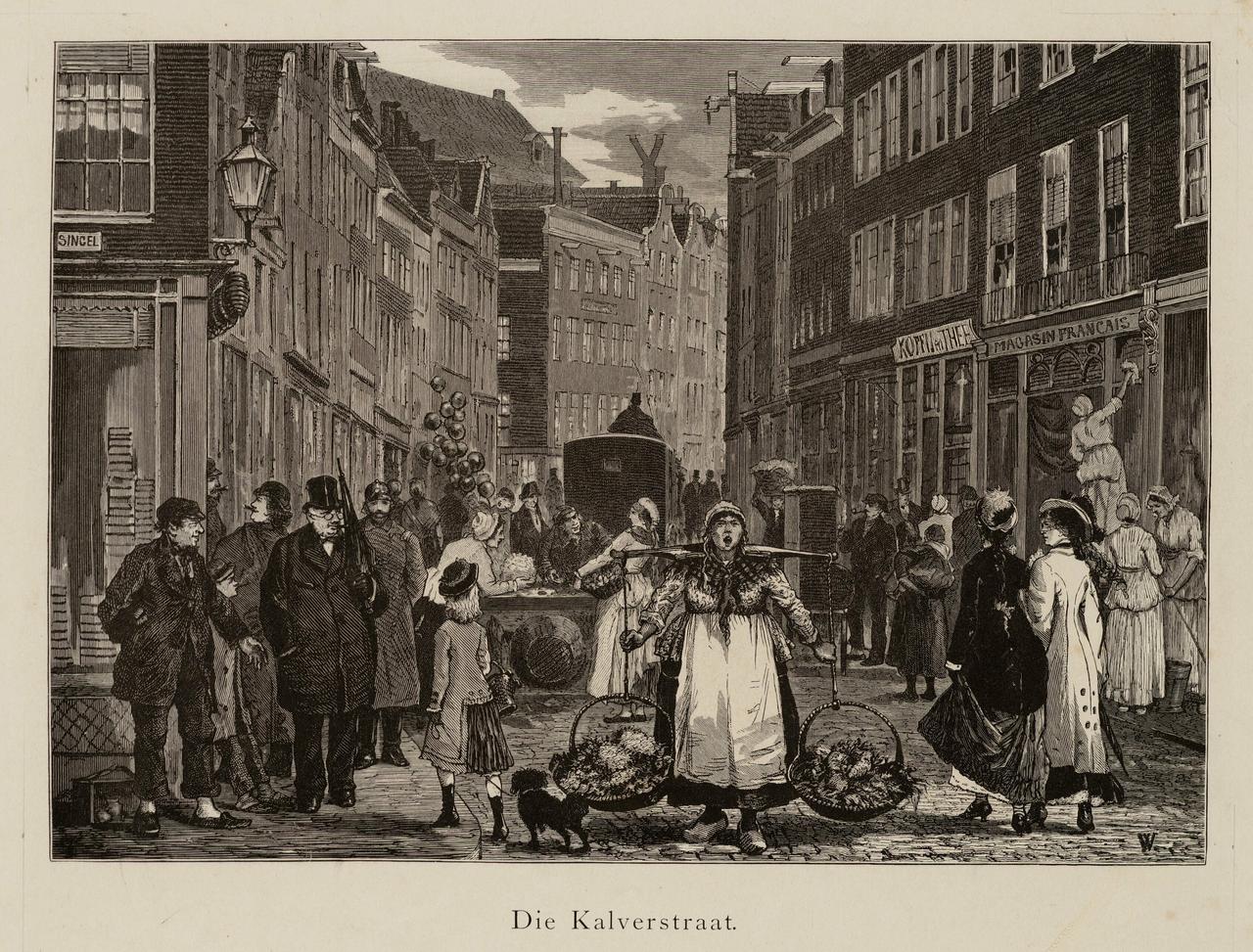
Kalverstraat
We are now in one of Amsterdam's most historic streets, namely the Kalverstraat. Originally it was the western dike of the Amstel, with Nieuwendijk as its extension. Outside the city limits, it was known as Die Lane as early as the 14th century. But where does the name Kalverstraat come from? In the Middle Ages, a calf market was held here, which took place at this location until the early seventeenth century. The market then moved to today's Reguliersbreestraat. Since then, this street has been referred to as Kalverstraat and this was mentioned as early as in 1393.
The section between the Spui and the Regulierspoort (Munttoren) was also used as a cattle market from 1486 to 1629 and was therefore known as the Ossenmarkt. Later, this section was also named Kalverstraat. The bridge over the Spui, which no longer exists today because it was filled in in 1882, was known as the Osche Lock. The houses on Kalverstraat used to have canal gardens, but these have all disappeared over time due to construction.
Besides the interesting name history of the street, Kalverstraat also has a rich history of events worth exploring. One of the most remarkable historical facts that took place between Kalverstraat and Rokin is the Miracle of Amsterdam in 1345. This miraculous incident took place in a house in this neighbourhood. To commemorate this event, the Catholic Stille Omgang is still held every year. This is a nocturnal march of silent Catholics that partly passes through Kalverstraat.
In addition, the first public film exhibition, directed by Auguste and Louis Lumière, took place here in 1896. Today, it is a car-free shopping street with more than 150 shops, making it one of the most visited places to shop in Amsterdam.
Any feedback for this story?