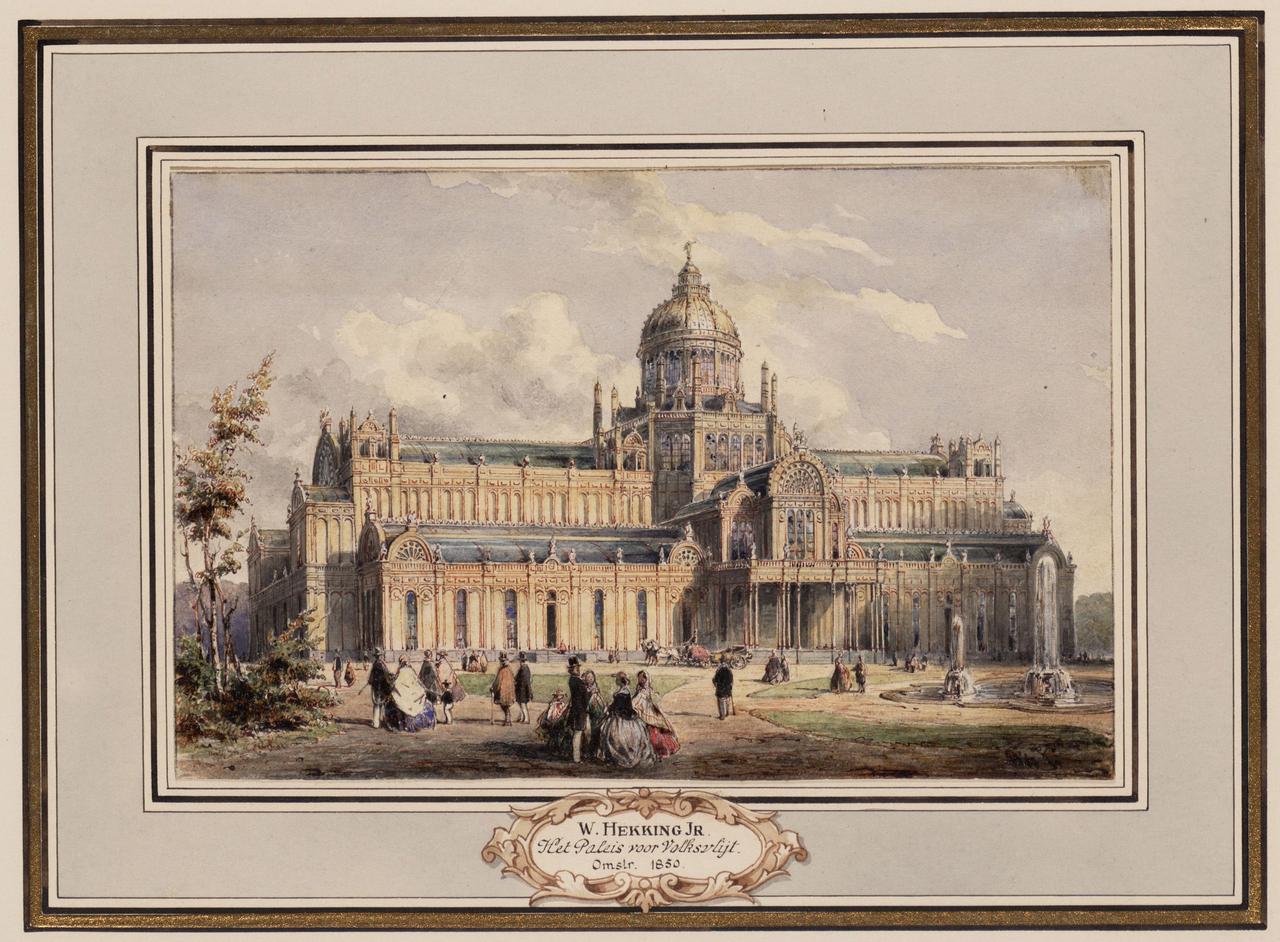
Palace of Volksvlijt
Now you look up against the building of De Nederlandsche Bank, but nearly a hundred years ago one of Amsterdam's largest and most impressive buildings stood here: the Paleis voor Volksvlijt.
Built in 1864 modeled after the Crystal Palace in London (see attached photo), the Paleis voor Volksvlijt was a masterpiece of glass and cast iron. The Crystal Palace, the original inspiration, was also later destroyed by fire - as was the Amsterdam palace.
Initiator Samuel Sarphati, an idealistic physician and entrepreneur, dreamed of a place where art, commerce and industry came together for the common good. The building was to be a model of progress, innovation and civilization - a monument to the people.
On Frederick Square, a magnificent palace rose 64 meters wide, 145 meters deep and 27 meters high, with a majestic dome that towered up to 55 meters into the sky. Inside took place exhibitions, concerts, balls and even international trade fairs. Inside the building was a sparkling passage with stores, cafes and galleries - a place where both the elite and the ordinary Amsterdammer could marvel at the world of art and industry.
Yet the building did not live a long life in its full glory. After Sarphati's death, the project lost its idealistic direction. Instead of cultural uplift, it increasingly became a commercial center. During the twentieth century, the building fell into disrepair. In 1929 the rear was demolished and on April 17 that year the main building went up in flames. Only part of the original passage remained, until that too disappeared in the 1960s to make way for De Nederlandsche Bank.
Any feedback for this story?