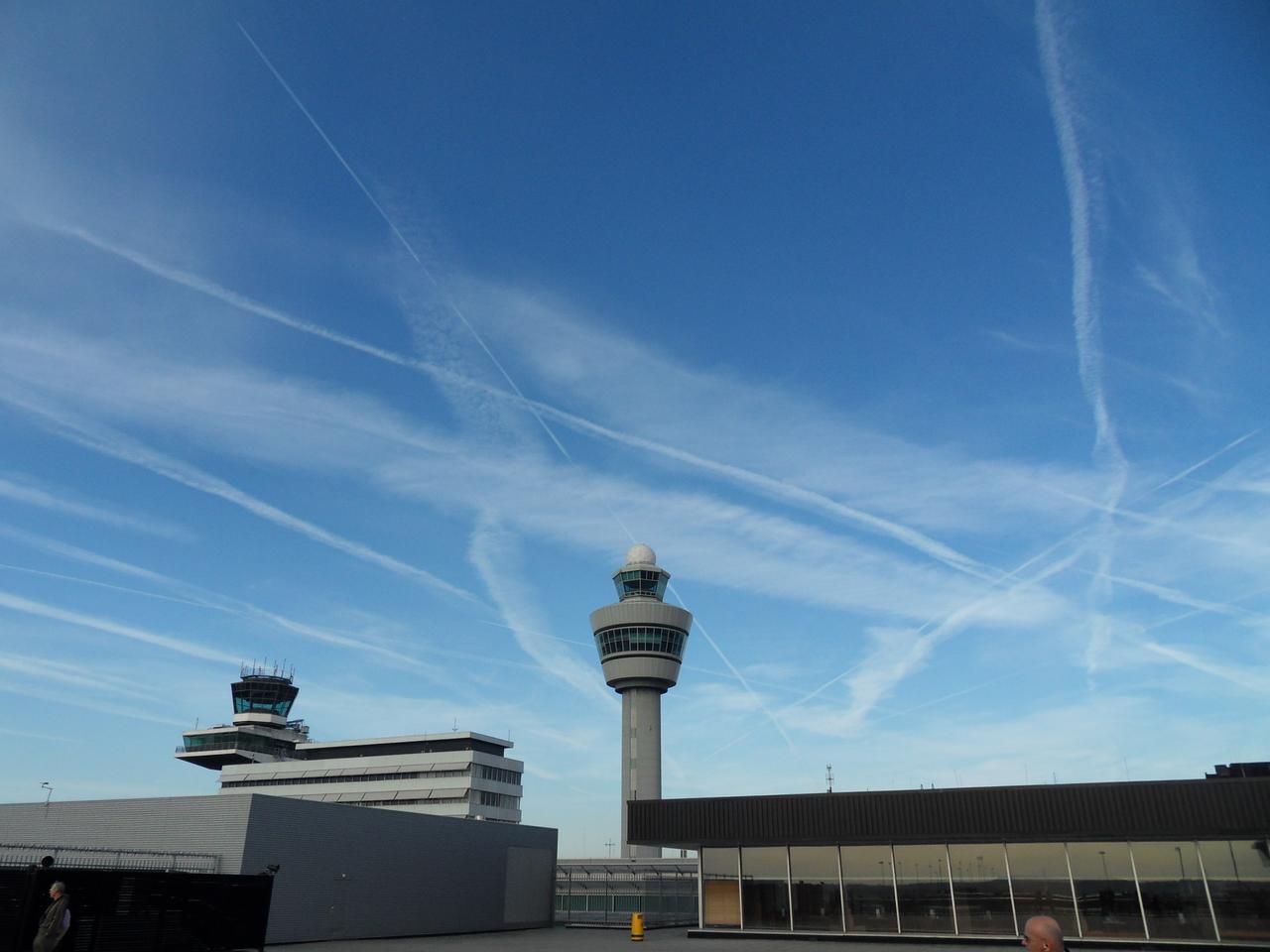
Schiphol today
After the devastating effects of World War II, Schiphol began an unprecedented rebuilding process from scratch. Although the airport expanded significantly in the latter part of the last century, this expansion evoked criticism.
In the 1990s, a new master plan for Schiphol as a Mainport was drawn up. This plan led to a major metamorphosis, including the doubling of the terminal building with the addition of Terminal 3. The lounge area in Terminal 2 was also significantly enlarged and an expanded train station was built under the heart of Schiphol. This train station underwent an expansion from 3 to 6 tracks and received a new rail tunnel parallel to the existing station with 2 extra tracks. This tunnel was completed in the year 2000, while offices and hotels found their place at Schiphol-Centre.
Government policy was and is aimed at supporting Schiphol's mainport function, parallel to the port of Rotterdam. A mainport functions as a regional centre and serves as a gateway to a vast hinterland, with Western Europe as the main reference. A region of intensive economic activity often develops around a mainport. Nevertheless, this development has also brought challenges, especially in terms of the impact on the health of local residents, due to noise pollution, particulate matter and CO2 emissions.
Schiphol has plans to further increase its capacity, aiming to facilitate 70-80 million passengers and between 600,000 and 650,000 flights per year. For many decades, there has been speculation about the possibility of relocating Schiphol to a location off the coast in the North Sea, as a possible solution to reduce nuisance for the 1.5 million local residents located near Schiphol or under one of its approach routes. Although this relocation was not yet concretely considered in 2019, it is seen by many as a promising idea to improve living conditions for this community.
Any feedback for this story?