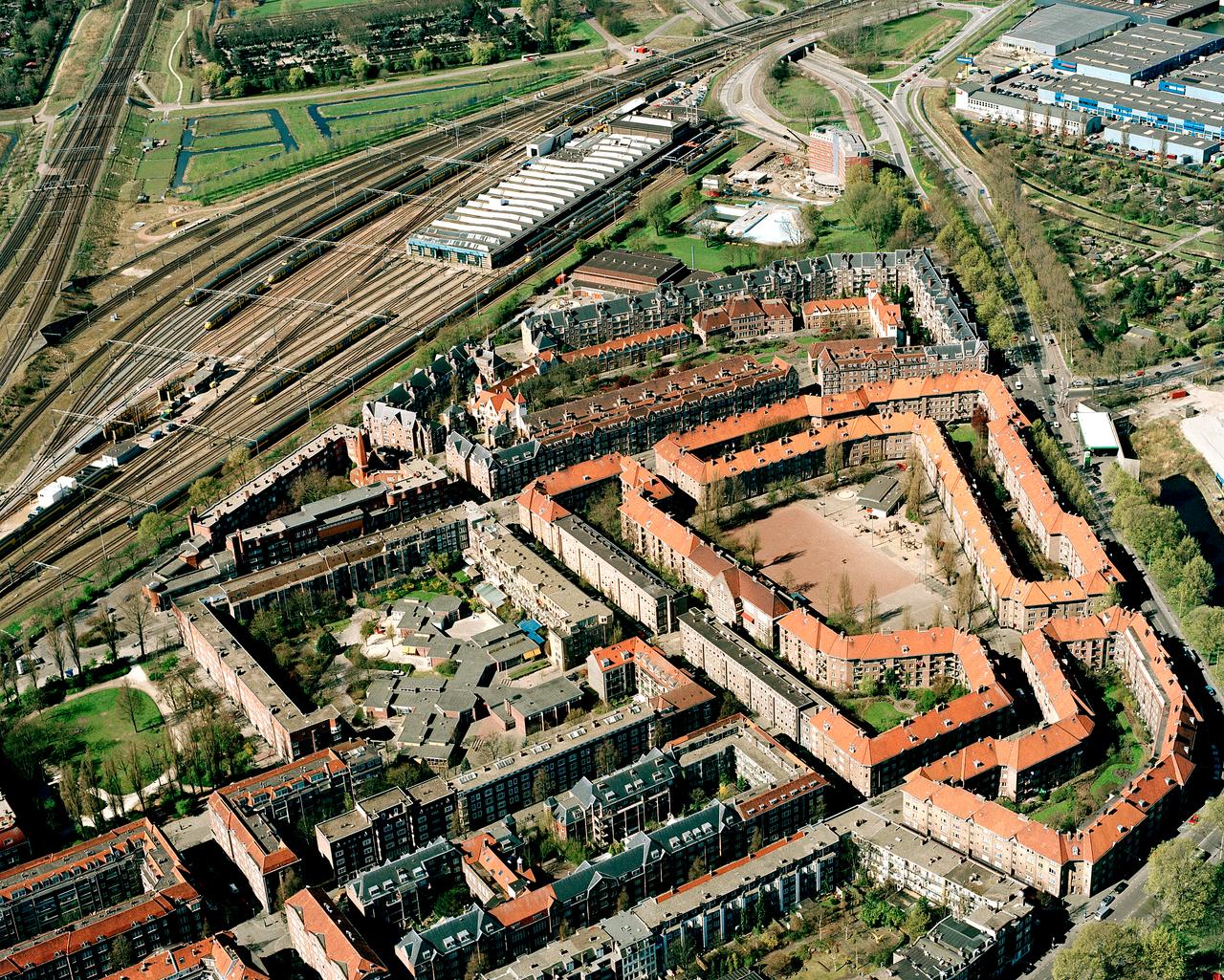
Spaarndammerbuurt
At the beginning of the twentieth century, the Spaarndammerbuurt was a place of extremes. On the edge of the Western Docklands, between the warehouses, railroad lines and canals, grew a neighborhood where life was hard for workers. They lived with large families in cramped quarters, in dank alleys and dilapidated buildings. Children slept three to a mattress, the toilet was often shared with several households, and fresh air was scarce.
Yet one of the Netherlands' most high-profile social housing experiments would emerge right here.
Under pressure from housing shortages and social unrest, the City of Amsterdam began encouraging housing associations around 1900. Architects were commissioned to design decent, affordable housing - but some went further. Much further.
The Amsterdam School found its stage in the Spaarndammer neighborhood. Think of the famous 'Het Schip', designed by Michel de Klerk. A worker's house as a palace, with expressive facades, ornate brickwork and turrets that you would sooner expect to find in a fairy tale than in a working-class neighborhood. Art and architecture were not a luxury here, but a right.
The contrast could hardly be greater: on the one hand, the hovels and unhealthy housing in which many workers lived, on the other, the new housing that literally and figuratively pulled them out of the mud. For some it felt like a reward, for others like a dream still out of reach.
Still, the neighborhood brought hope. The Spaarndammerbuurt became a testing ground for better public housing - not just a place to live, but to live on. With schools, bathhouses, libraries and squares. A neighborhood built on the belief that everyone was entitled to beauty, even - or especially - if you worked in the harbor, with calluses on your hands and wind in your face.
Any feedback for this story?