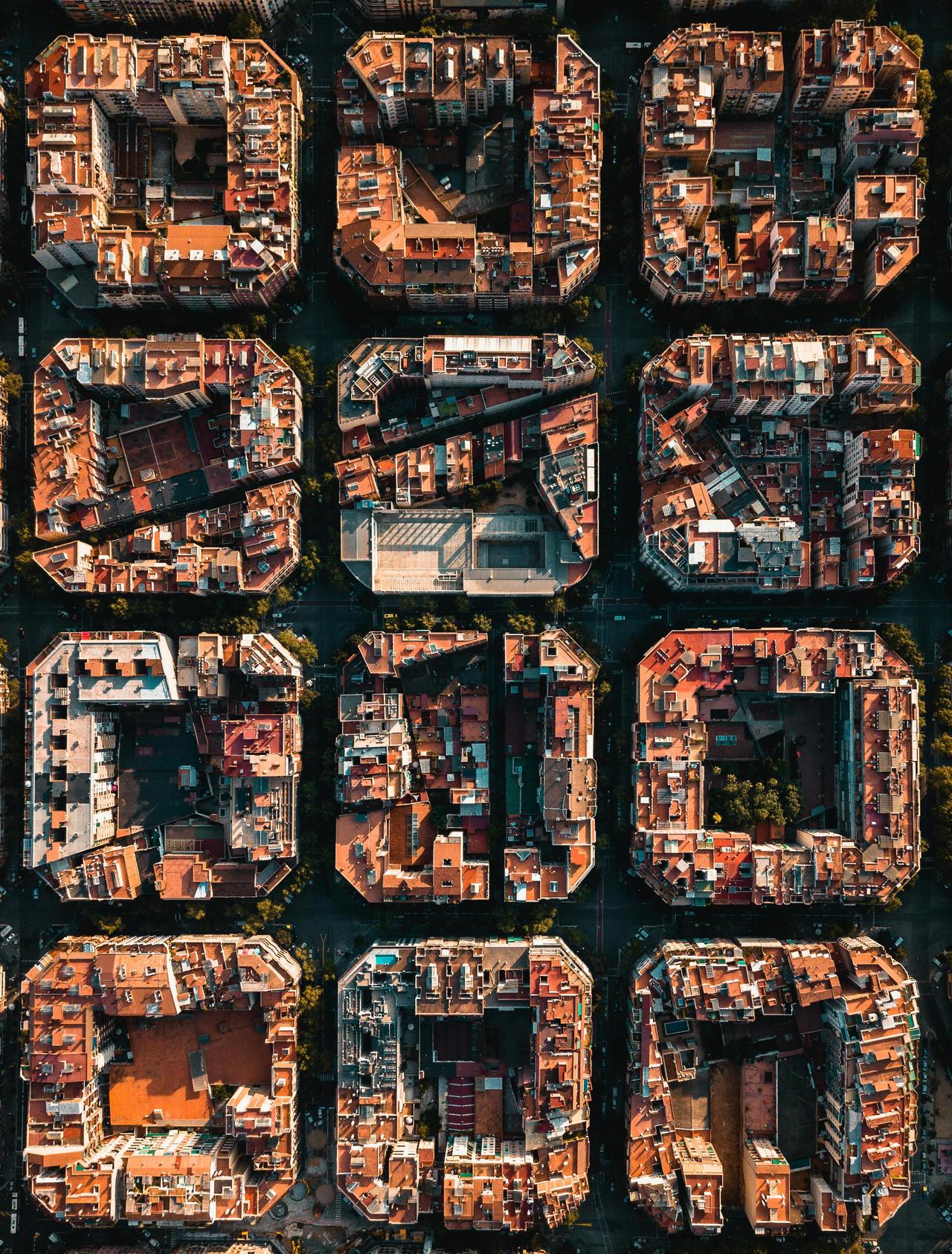
Eixample district
Imagine a city so overcrowded that working-class residents lived only 23 years on average, packed into medieval streets where cholera spread like wildfire. This desperate reality sparked one of history's boldest urban experiments. Stretching between the Gothic Quarter and the old villages of Gràcia and Sarrià, this district became the world's first scientifically planned neighborhood. By 1854, the walled city was suffocating with 1500 people per hectare.
The government finally approved tearing down the ancient walls, creating space for something revolutionary. Civil engineer Ildefons Cerdà won the commission in 1859 with a radical vision. His grid of 420 identical octagonal blocks, each measuring 113 by 113 meters, prioritized human health over profit. Every block was designed to provide 6 cubic meters of air per person, with interior gardens, wide 35-meter streets for sunlight and ventilation, and evenly distributed hospitals, schools, and markets every few blocks. Cerdà even invented the word urbanization to describe his scientific approach. Developers had other plans.
They built on all four sides instead of two, eliminated the gardens, and constructed higher buildings. Yet the district flourished, becoming home to 260,000 residents and hosting Antoni Gaudí's masterpieces: the soaring Sagrada Família, the undulating Casa Milà, and the fantastical Casa Batlló along the elegant Passeig de Gràcia. Cerdà never saw a single payment for his life's work and died broke in 1876.
Any feedback for this story?