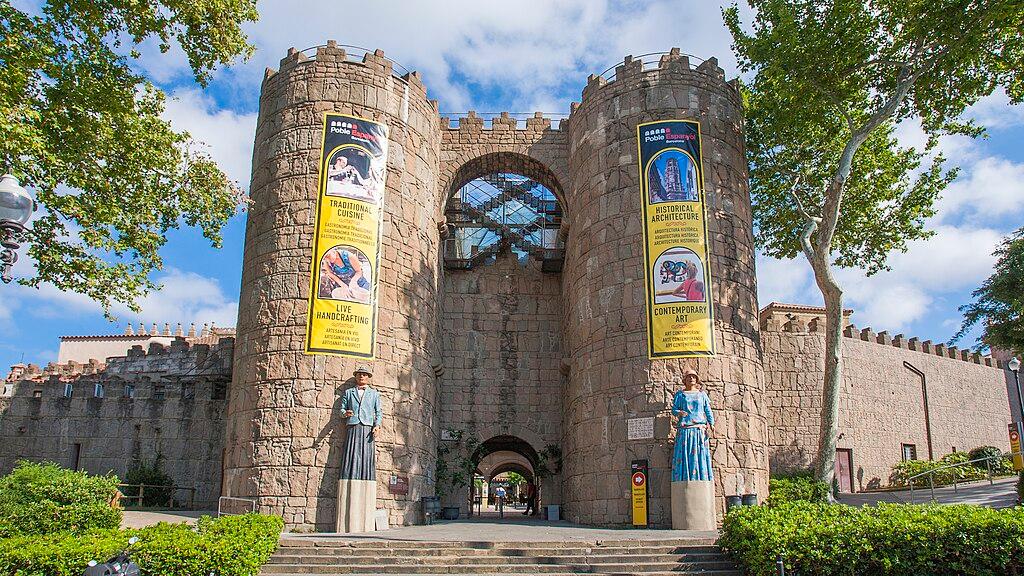
El Poble Espanyol
We are standing before an entire Spanish village that was never meant to survive. Near the Magic Fountain on Montjuïc hill sits El Poble Espanyol, an open air architectural museum where 117 full scale buildings from across Spain stand side by side in a space smaller than seven football fields. In 1927, four professionals set out on an ambitious journey. Architects Francesc Folguera and Ramon Reventós, art critic Miquel Utrillo, and painter Xavier Nogués traveled to over 600,000 sites across the country, photographing and sketching architectural treasures.
Their goal was bold: create a living village that captured the essence of Spanish architecture for the 1929 International Exposition. Construction began in January 1928 and finished just 16 months later. Workers reproduced everything from Andalusian courtyards to Basque farmhouses, medieval monasteries to Renaissance palaces. The 49,000 square meter village was designed to be temporary, demolished within 6 months of the Exposition closing. But visitors loved it too much. Public enthusiasm saved the village from destruction.
During the Spanish Civil War, it served as a prison camp. The site later became home to artisan workshops and the Fran Daurel Museum, which houses works by Picasso, Dalí, and Miró. More than a million people walk these streets annually, exploring centuries of architectural history compressed into an afternoon.
Any feedback for this story?