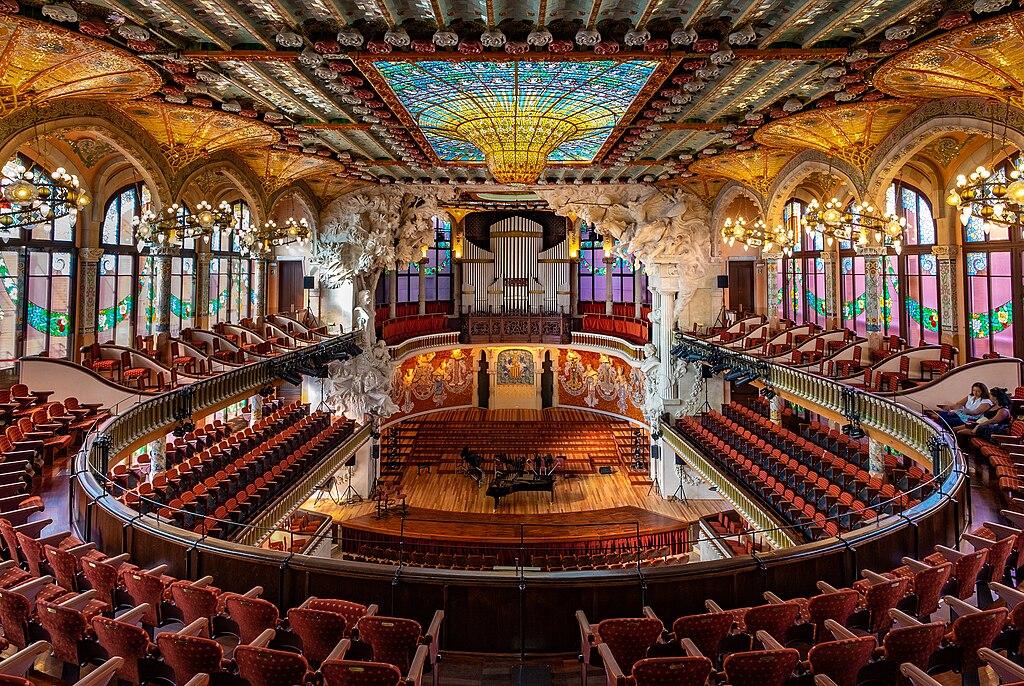
Palau de la Música Catalana
Step into the only concert hall in Europe illuminated entirely by natural sunlight. Nestled in the narrow streets of the Sant Pere neighborhood, this extraordinary building reveals a world where architecture becomes music itself. The Palau de la Música Catalana was born from the vision of the Orfeó Català, a choral society founded in 1891 to preserve Catalan musical heritage. When the choir needed a permanent home, they commissioned architect Lluís Domènech i Montaner to create something unprecedented.
Between 1905 and 1908, he crafted what he called a garden for music, using revolutionary iron frameworks and vast glass walls that flood the interior with light. The concert hall seats 2,200 beneath a stunning inverted dome skylight of golden and blue stained glass that glows like the sun itself. Surrounding the stage, 18 sculpted muses play different instruments, their lower bodies rendered in vibrant mosaics. On one side stands a bust of Beethoven representing classical music, on the other, Anselm Clavé symbolizing Catalan folk traditions.
Funded entirely by public donations from merchants and industrialists, the palace embodied Catalan cultural pride. In 1997, UNESCO recognized it as a World Heritage Site, the only modernist concert hall to receive this honor. More than 500,000 visitors annually experience performances from classical symphonies to contemporary jazz within these luminous walls.
Any feedback for this story?