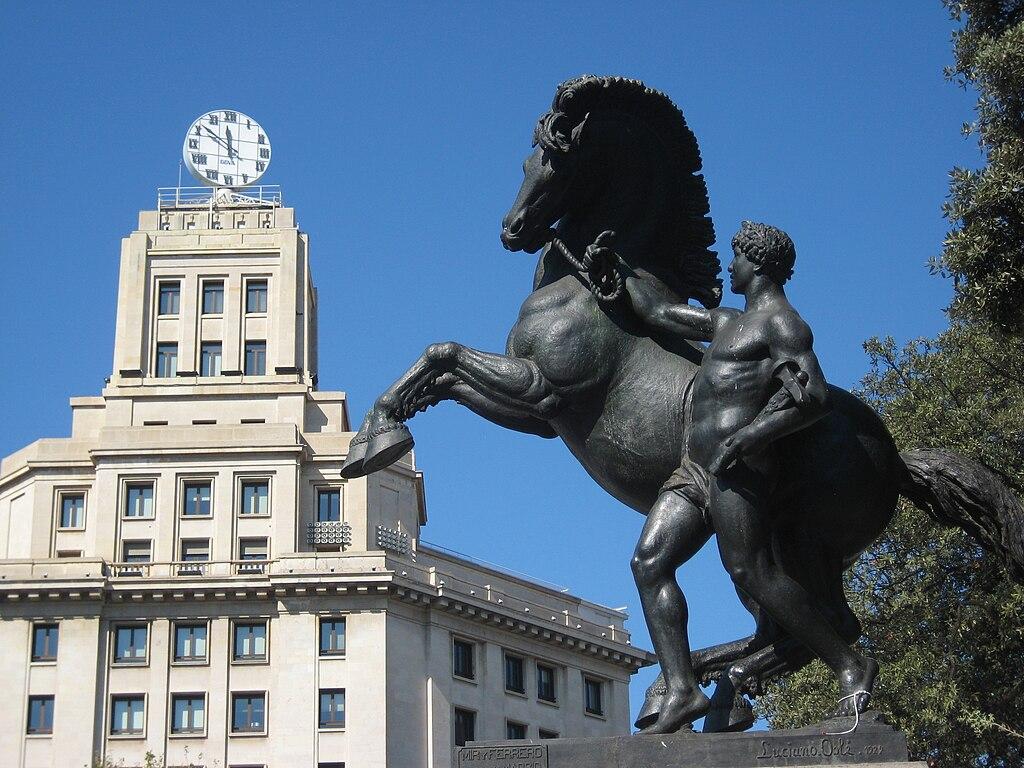
Plaça de Catalunya
This vast square stands on what was once open farmland beyond the city walls. Less than 200 years ago, none of this existed. At the junction where the medieval old town meets the modern Eixample district, this 50,000 square meter space marks the exact boundary of ancient fortifications. When authorities finally demolished those walls in 1854, the city could breathe and expand. Urban planners immediately saw potential for a grand central plaza.
The square was first proposed in 1859 under the Plan Rovira, but bureaucracy delayed construction for decades. Work finally began in 1902, though the space remained incomplete and underused. Everything changed when the city prepared for the 1929 International Exhibition. Architects Pere Falqués, Josep Puig i Cadafalch, and Francesc de Paula Nebot designed the layout we see now. King Alfonso XIII inaugurated the finished square on November 2, 1927.
Within months, banks moved in, grand hotels opened their doors, and Café Zurich became the meeting spot for artists and intellectuals. The plaza quickly became the city's nerve center, connecting nine major streets including La Rambla and Passeig de Gràcia. Nearly 30 sculptures by celebrated Catalan artists were installed for the 1929 Exhibition. Underground, multiple metro lines converge, making this one of the busiest transport hubs in the entire region.
Any feedback for this story?