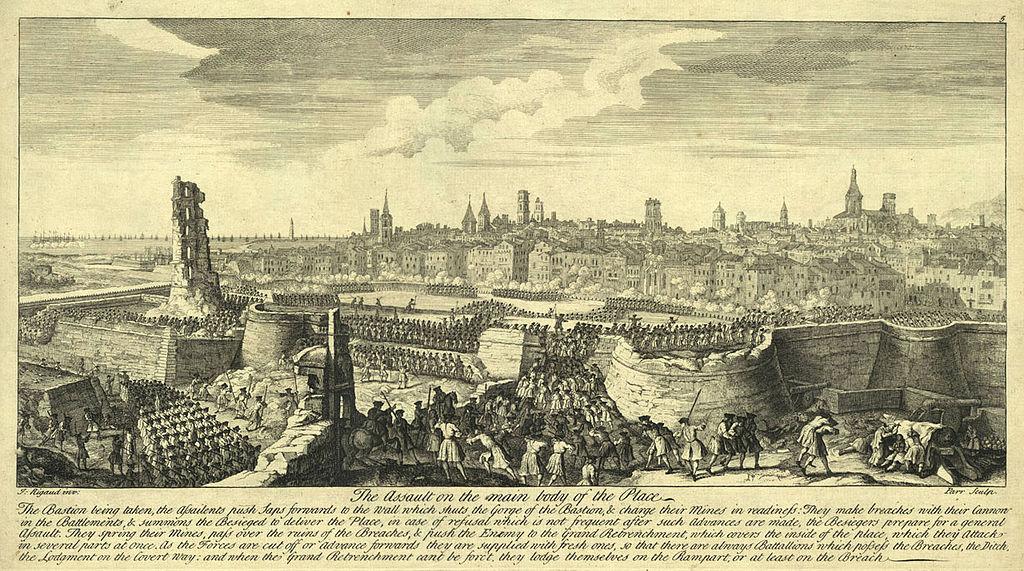
Spanish War of Succession
On September 11, 1714, the streets ran red with blood as 20,000 Franco-Spanish troops finally broke through the walls after a brutal 13-month siege. In the narrow alleys of the Gothic Quarter, where ancient stone buildings still bear scars from cannon fire, this city became the last battlefield of the War of the Spanish Succession. The conflict erupted in 1700 when Spain's childless King Charles II died, leaving Europe's greatest empire up for grabs.
He named Philip of Anjou, grandson of France's Louis XIV, as heir. Austria, Britain, and the Dutch Republic refused to accept a unified French-Spanish superpower. They backed Archduke Charles of Austria instead, igniting 14 years of devastating war across the continent. This Catalan capital threw its support behind the Archduke in 1705, desperate to protect its ancient laws and self-governing institutions from French-style absolutism. When Britain and the Dutch signed the Treaty of Utrecht in 1713, they abandoned their Catalan allies.
The city stood alone against overwhelming odds. Duke of Berwick's forces surrounded the defiant defenders with heavy French artillery, deliberately targeting homes and civilians rather than fortifications. The final assault began at 4:30 in the morning, killing the military commander Rafael Casanova and thousands of citizens. The defeat abolished Catalonia's independence and imposed Castilian rule, transforming Spain from a confederation into a centralized kingdom.
Any feedback for this story?