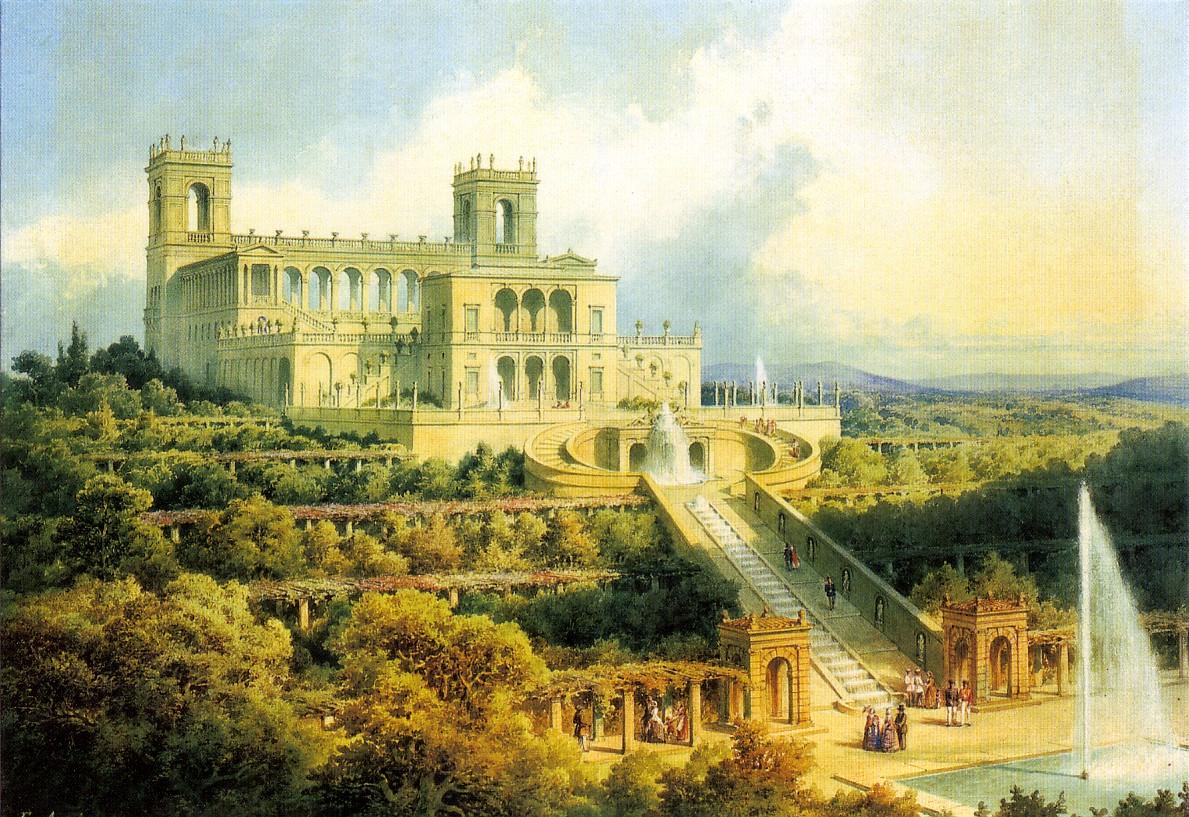
Belvedere on Pfingstberg
Perched atop the scenic Pfingstberg hill in Potsdam stands the Belvédère, a striking palace with a history as fascinating as its architecture. Commissioned in the 19th century by Frederick William IV of Prussia, it was conceived as a tribute to the beauty of Italian villas. The idea, however, had already been envisioned by Frederick William II in 1793, though his plans never materialized.
The land, then called Judenberg, remained in royal hands. Decades later, Frederick William IV, inspired by the Italian Renaissance and the Villa Farnese in Caprarola (1585), sketched his vision for the Belvédère. Construction took place in two phases: from 1847 to 1852 and from 1860 to 1863. Architects Ludwig Persius, Friedrich August Stüler, and Ludwig Ferdinand Hesse translated the king’s vision into reality. Though never fully completed, the palace radiates elegance and grandeur.
The surrounding gardens, designed by landscape architect Peter Joseph Lenné, added harmony and beauty. Below the Belvédère lies the Pomona Temple, often overlooked by visitors. This pavilion is remarkable as the very first building designed by Karl Friedrich Schinkel. With its neoclassical design, it forms an integral part of the Pfingstberg ensemble. Today, visitors can explore an exhibition under the northern arcade of the Belvédère, offering insight into its history, the ambitions of Prussian royalty, and the artistic influences behind its creation.
Any feedback for this story?