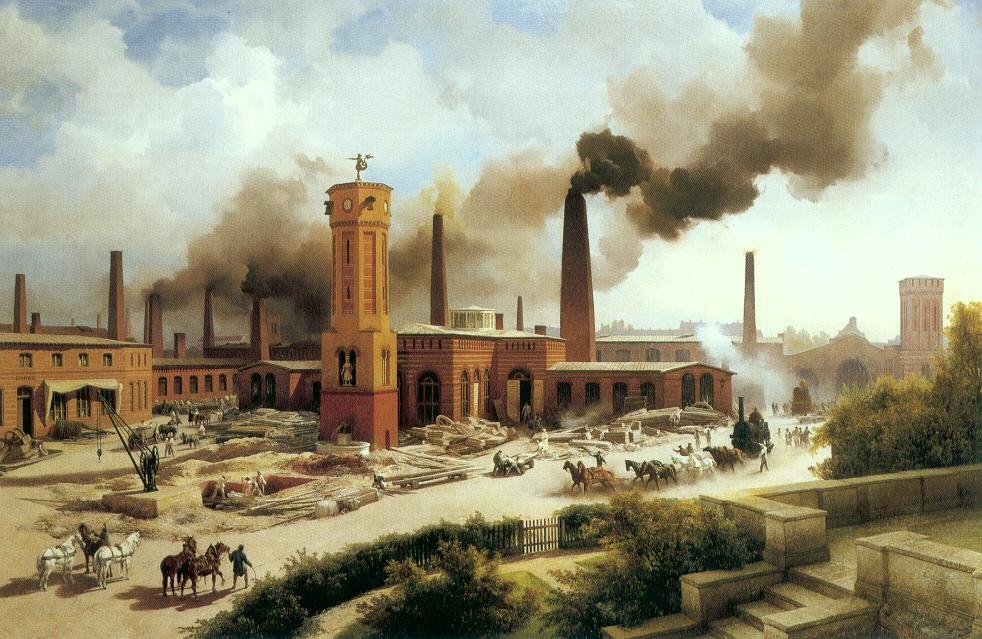
Borsig factory grows – 1850s
In the early 1830s, August Borsig, a skilled mechanic and entrepreneur, established his first machine factory in Berlin, focusing on building steam engines and locomotives. His early work reflected both precision engineering and ambition, aiming to compete with established British locomotive makers. By 1841, Borsig had completed his first steam locomotive, which successfully ran on German railways and demonstrated that local manufacturing could match international standards. The achievement marked the beginning of a growing reputation for quality and reliability in German industrial engineering.
The 1850s brought rapid expansion. In 1847, Borsig began constructing a new ironworks in the Moabit district, which started operations in 1849. Around 1850, the company acquired an additional machine factory and foundry on Kirchstraße. By then, Borsig employed approximately 1,800 workers across these sites, a significant workforce for the era. This growth was closely tied to Germany’s expanding railway network. Demand for locomotives soared, and Borsig’s company supplied engines both domestically and internationally, positioning Berlin as an important hub for industrial innovation.
Borsig also paid attention to his workers’ welfare. He introduced a sickness fund, a funeral expense fund, and a savings bank for employees. The factory included facilities such as an instruction room, a dining hall, and even a bathhouse with a swimming pool, reflecting a commitment to supporting workers beyond wages. By the mid-1850s, the company had solidified its status as a leading locomotive manufacturer. In 1854, Borsig completed the 500th locomotive, an achievement that coincided with him receiving the title of Geheimer Kommerzienrat, or Privy Commerce Councillor, in recognition of his contributions to German industry.
Any feedback for this story?