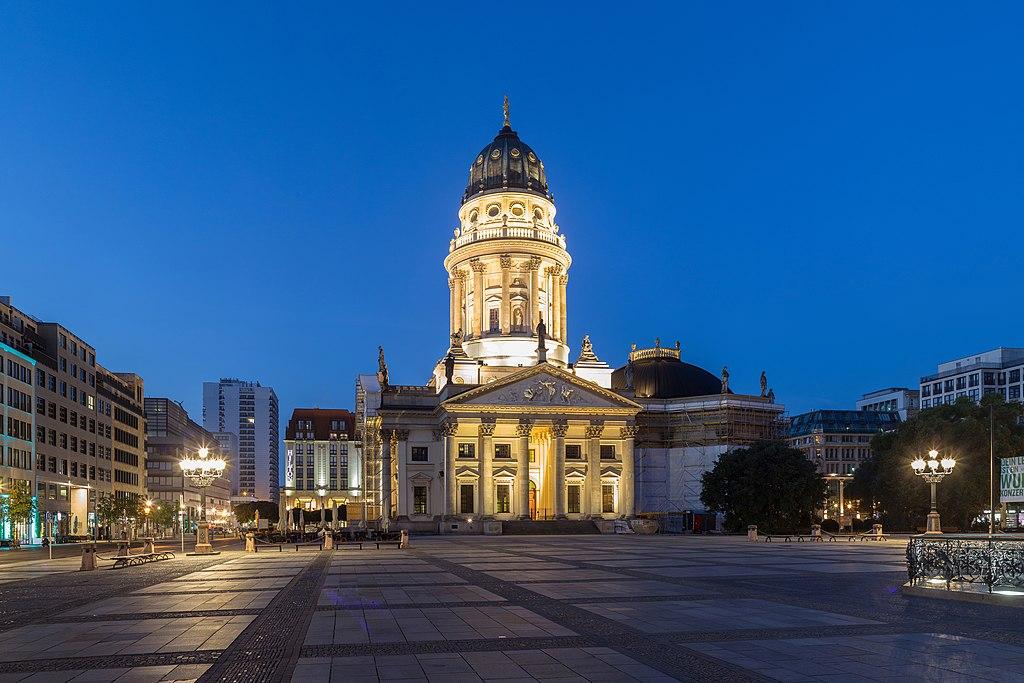
Deutscher Dom
On Berlin’s historic Gendarmenmarkt square, the imposing Deutscher Dom stands as a monument to the city’s eventful past. This baroque structure was originally built in 1708 by architects Martin Grünberg and Giovanni Simonetti, commissioned by Frederick I of Prussia for the Protestant community. The construction of its dome marked a new phase in Berlin’s renewal, showcasing the monarchy’s ambitions.
Later, Frederick the Great enhanced the site by enlarging the tower dome of the Deutscher Dom while also ordering the elevation of the Französischer Dom’s dome on the opposite side of the square. These projects were part of his vision to beautify the Gendarmenmarkt and highlight Berlin’s architectural splendor. The Deutscher Dom also played a key role in revolutionary history. In March 1848, 183 coffins of victims of the March Revolution were solemnly placed on its steps.
During the ceremony, Protestant, Catholic, and Jewish clerics delivered moving speeches before the funeral procession continued to the Friedhof der Märzgefallenen. World War II caused heavy damage to the dome, but careful reconstruction in the 1990s restored the building. Since 1996, it has served as a museum hosting the exhibition “Fragen an die Deutsche Geschichte” (“Questions to German History”), offering visitors deep insights into Germany’s milestones and challenges.
Any feedback for this story?