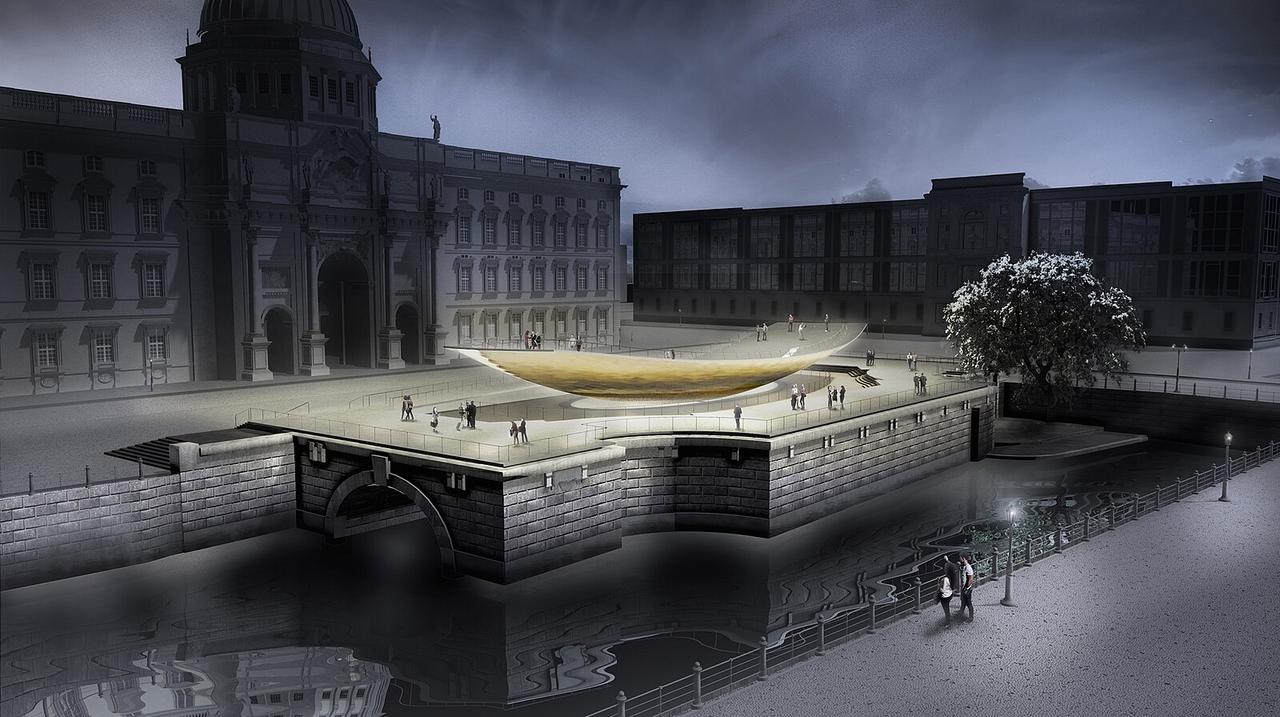
Freedom Monument planned – 2010s
Near the site of the former Kaiser Wilhelm National Monument in central Berlin, plans emerged in the 2010s to build a new memorial celebrating Germany’s reunification. The Monument to Freedom and Unity, or "Einheitsdenkmal," was designed to honor the peaceful revolution of 1989 and the efforts of citizens who helped bring East and West Germany together. The design is striking and interactive. A massive steel dish, capable of holding around 1,400 people, tilts when at least twenty individuals stand on one side.
This motion symbolizes how collective effort is necessary to achieve unity. The top surface is inscribed with “Wir sind das Volk” (“We are the people”) and “Wir sind ein Volk” (“We are one people”), while the underside displays images from the fall of the Berlin Wall. Visitors are encouraged to step onto the monument, making the experience both physical and symbolic. The memorial’s location is significant.
The plinth once supported the Kaiser Wilhelm National Monument, and the area was central to the 1989 demonstrations that contributed to the peaceful revolution. In 2007, the Bundestag approved the monument, and by 2008 it was included in the federal memorial concept. Construction faced delays due to environmental concerns, funding challenges, and debates about the design. Work eventually began in 2020, aiming to create a lasting tribute to the courage and cooperation that led to reunification.
The Monument to Freedom and Unity is more than a static structure. Its interactive design connects people to the history it commemorates, inviting reflection on past events and the collective effort required to achieve freedom and unity. It stands as a reminder of the citizen-led revolution that reshaped Germany and continues to inspire participation in shaping a shared future.
Any feedback for this story?