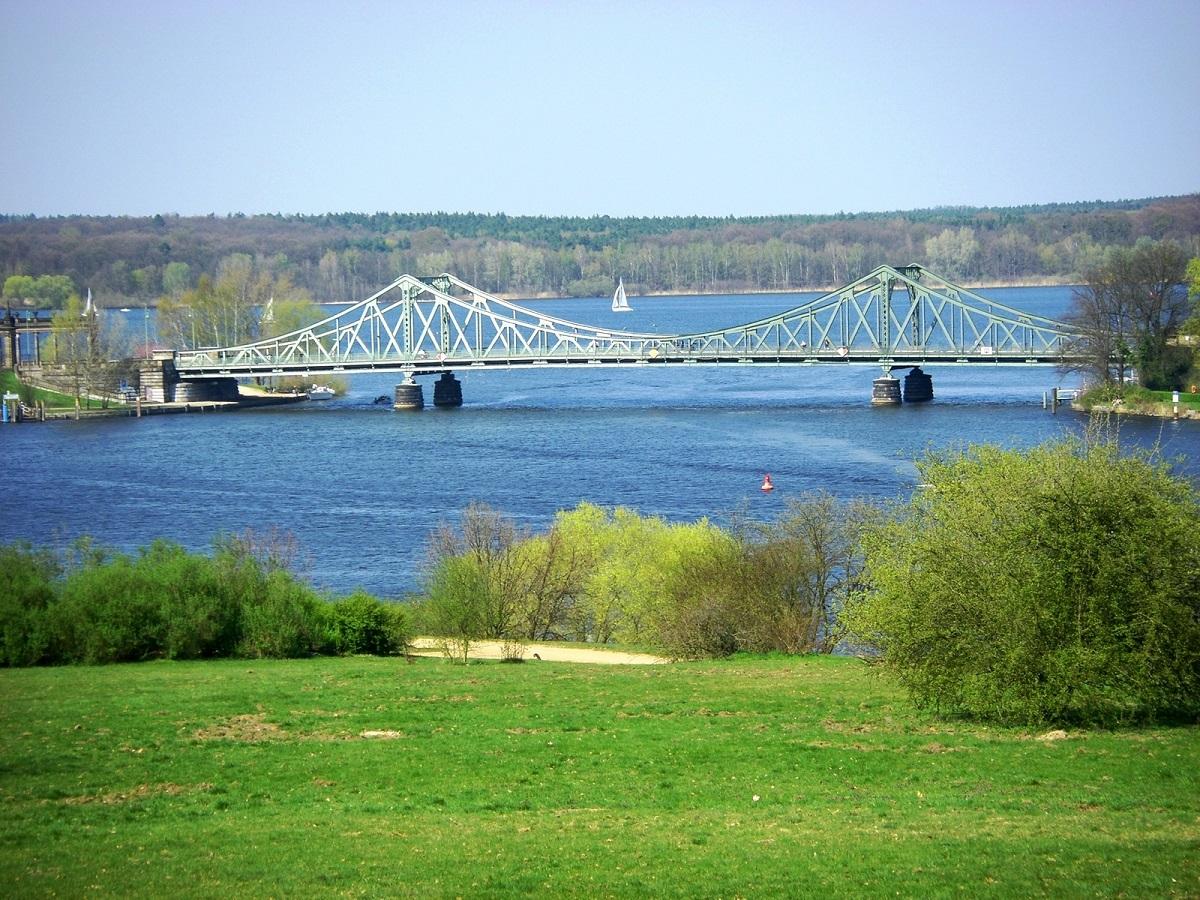
Glienicke Bridge
The Glienicke Bridge, often called the “Bridge of Spies”, is steeped in history and intrigue. During the Cold War, it served as a vital link between East Germany and West Berlin. But its significance dates back much further. At the end of the 17th century, a wooden bridge was built here, and by 1754 it was strong enough to carry carriages, marking an important step forward for postal services. In 1907, the wooden structure was replaced by a modern bridge, which became part of the Reichsstrasse 1, a major highway connecting Aachen through Berlin to Königsberg.
Destroyed during World War II, it was rebuilt and reopened on December 19, 1949, under the name “Bridge of Unity” (Brücke der Einheit). Yet this unity was short-lived, as the bridge soon became a symbol of Cold War division. Several high-profile spy exchanges took place here. The most famous occurred on February 10, 1962, when American U-2 pilot Gary Powers was swapped for Soviet spy Rudolf Abel, an event later dramatized in the 2015 film Bridge of Spies. Another major exchange took place on June 11, 1985, involving 23 political prisoners from East Germany and four Eastern Bloc spies.
On February 11, 1986, the bridge again drew global attention when Soviet dissident Anatoly Shcharansky was exchanged, along with three Western spies, for five Eastern Bloc agents. The bridge also witnessed daring escapes. On the night of March 11, 1988, three East German men smashed through the border barriers in a truck at high speed, making it safely to West Berlin. After the fall of the Berlin Wall, the bridge was reopened to pedestrians on November 10, 1989. Today, the Glienicke Bridge stands as a powerful symbol of the Cold War. A subtle reminder of its divided past still exists: the steel is painted a darker shade of green on the Berlin side than on the Potsdam side.
Any feedback for this story?