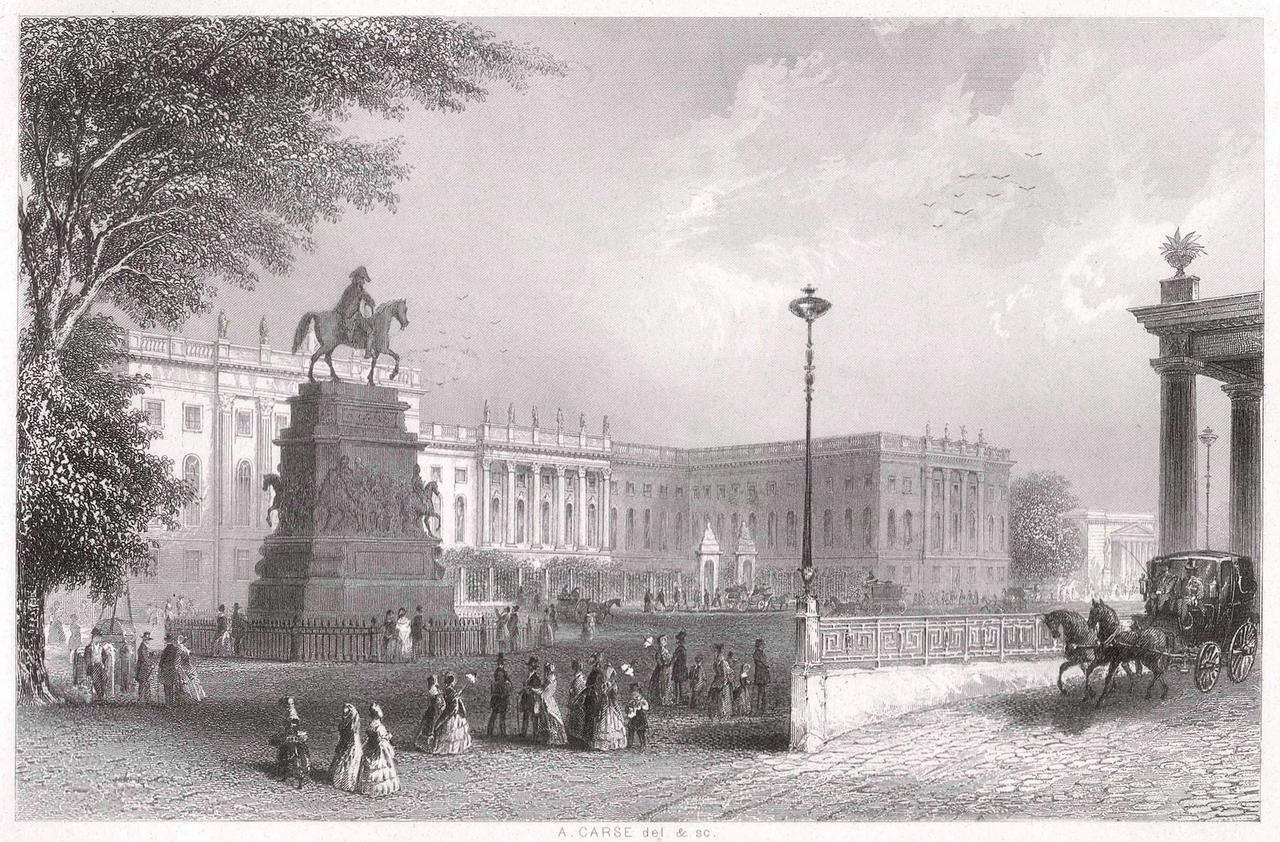
Humboldt University of Berlin
The building in front of you has a polished, authoritative look today, but when Humboldt University first opened in 1810, the inside told a different story. The rooms were bare, walls spotted with mould, not a desk or chair in sight. None of that stopped 256 students and 52 professors from showing up that October, because the founder, Wilhelm von Humboldt, had an idea powerful enough to outweigh the furniture problem.
His idea was simple but radical: research and teaching should be inseparable, and scholars should be free to follow knowledge wherever it leads. That model quietly spread across Europe and into the United States, shaping how universities work to this day.
The minds this place attracted were extraordinary. Hegel and Fichte shaped modern philosophy here. In mathematics, three figures, Ernst Kummer, Leopold Kronecker, and Karl Weierstrass, rewrote the rules of the discipline entirely. And the Charité, now one of the world's leading medical centres, joined the university in 1829 after starting life in the early 1700s as a plague isolation house. Quite the career change.
Beyond the main campus, the university stretches into an arboretum with nearly 4,500 tree species, and a park of 1920s wind tunnels from Germany's first airfield. Big ideas, it turns out, need a lot of space.
Any feedback for this story?