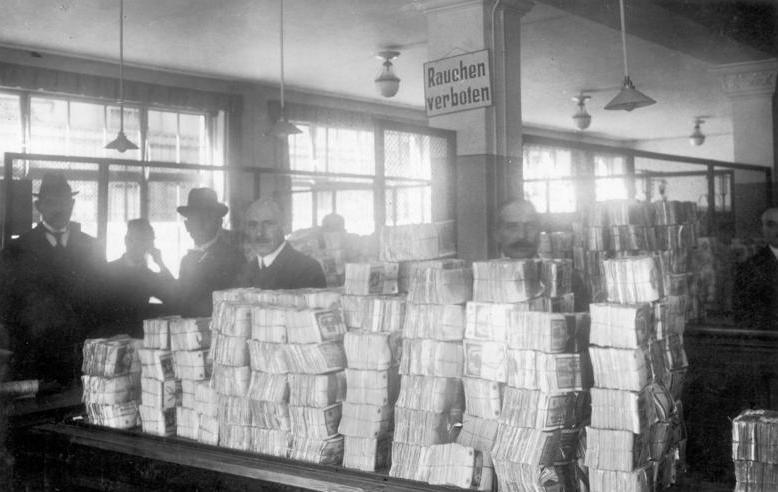
Hyperinflation chaos – 1922
In 1922, Berlin was gripped by an economic crisis few could have imagined. Money lost value almost by the hour, and ordinary daily life became a constant struggle. People carried bundles of banknotes to buy bread, yet even these stacks were barely enough for basic necessities. The origins of this turmoil lay in the aftermath of World War I. Germany had to pay enormous reparations under the Treaty of Versailles, totaling 132 billion gold marks. To meet these obligations, the government printed more money, triggering a rapid devaluation of the Papiermark.
By mid-1922, prices had already increased several hundred percent, and the hyperinflation was accelerating. In Berlin, wages had to be spent immediately. People rushed to markets and shops, fearing that by the time they reached the cashier, their money would be worthless. The cost of everyday items skyrocketed: a loaf of bread that cost around 160 marks at the start of the crisis became billions of marks within a year. Transactions became almost surreal, with endless zeros dominating every price tag.
The chaos also affected mental health. Accountants and cashiers developed what was known as “zero stroke,” a compulsive condition caused by constantly writing and calculating enormous numbers. The relentless pace of inflation made simple accounting tasks overwhelming. By late 1923, the crisis reached its peak: one U.S. dollar was worth over four trillion marks. To stabilize the economy, the German government introduced the Rentenmark, a new currency backed by land and industrial assets.
This move gradually restored confidence in money and ended the hyperinflation, but the experience left a lasting mark on German society. The hyperinflation of 1922–1923 is remembered not only for its extreme economic consequences but also for how it shaped everyday life, revealing the fragility of currency and the human struggle to adapt in the face of sudden financial collapse.
Any feedback for this story?