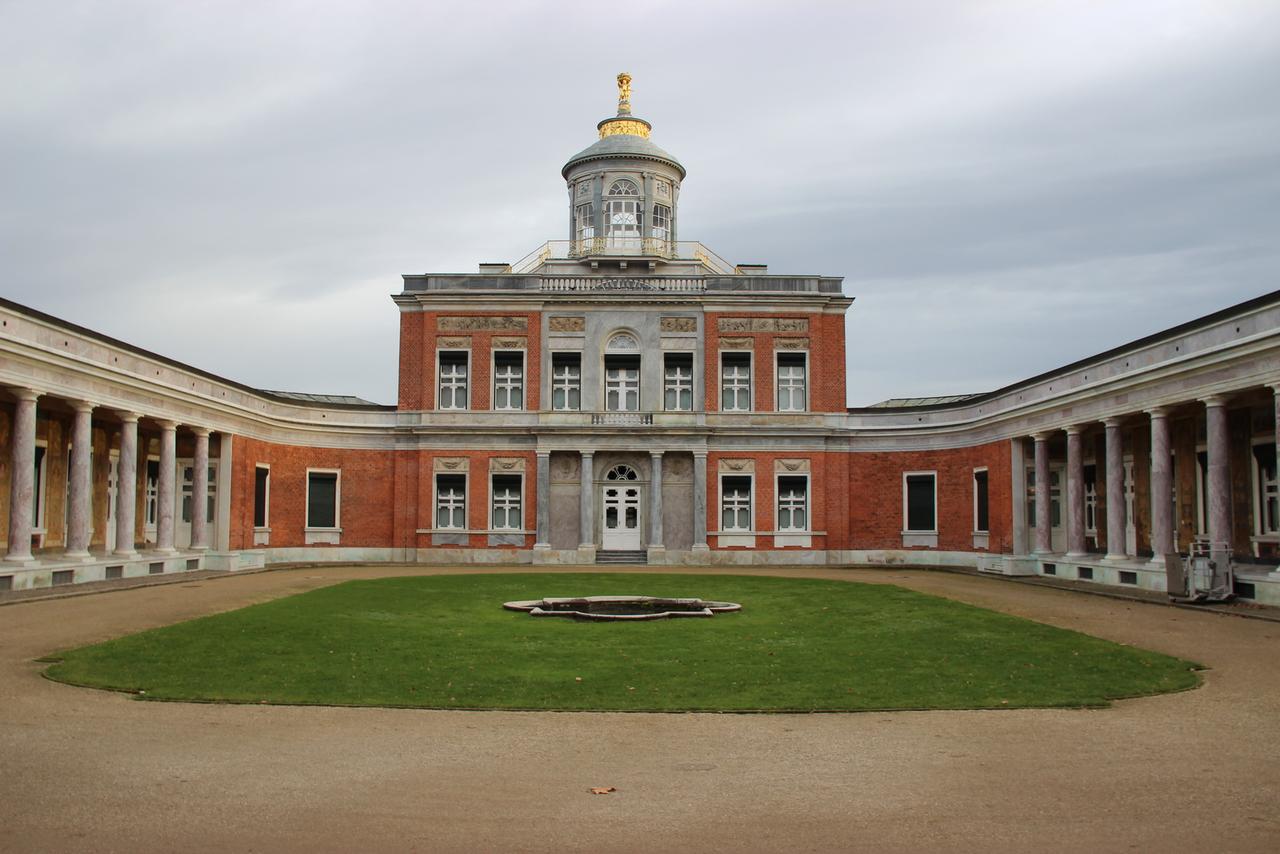
Marble Palace
Take a look at the Marble Palace, sitting quietly on the edge of Heiliger See in Potsdam. Its red-brick walls and neat, cube-shaped form are crowned with a round pavilion, giving the king who built it sweeping views of the lake, the New Garden, and even Peacock Island in the distance. It was built between 1787 and 1793 for King Frederick William II, who wanted something different from the ornate, baroque style of Sanssouci. The neoclassical look was in fashion across Europe, and here it appears in clean lines, calm proportions, and details made from pale Silesian marble—the feature that gave the palace its name.
Some of its most charming details are hidden from view. Beneath the terrace lies a small building designed to look like the remains of an ancient temple. This was the palace kitchen, connected by an underground tunnel to a grotto-style dining room inside. It meant food could arrive straight from the stove without servants crossing the lawns, and the design gave the whole place a playful, romantic touch. The marble itself has its own story. Alongside newly quarried stone, some columns were salvaged from older Prussian buildings, keeping fragments of past architecture alive in the new royal home.
Over the years, the palace housed different members of the Prussian royal family. Prince Wilhelm, later Emperor Wilhelm I, lived here for a time in the 1830s. Decades later, Crown Prince Wilhelm and his wife Cecilie made it their home until 1917. After the monarchy ended, it became state property and opened as a museum in 1932. It suffered damage during the Second World War, was taken over by the Soviet military, and from 1961 served as East Germany’s army museum.
Restoration work began in the 1980s and continued after reunification, with the interiors completed in 2006 and the exterior in 2009. Today, the Marble Palace is part of a UNESCO World Heritage site. Inside, it holds one of the largest historical Wedgwood collections outside England, still displayed much as it was more than two centuries ago.
Any feedback for this story?