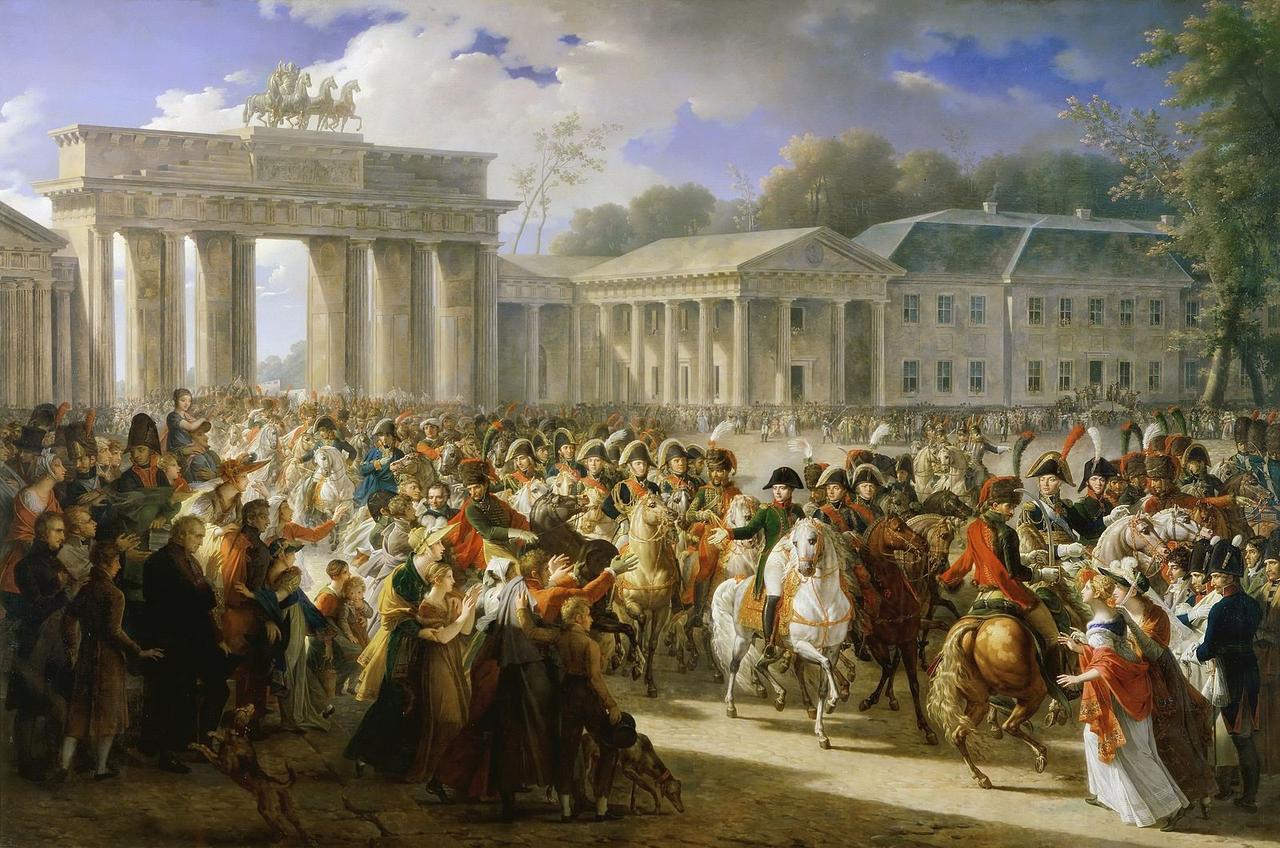
Napoleon's occupation – 1806
Under the autumn sky of 1806, Berlin faced a moment that would change its history forever. On October 27, Napoleon Bonaparte entered the city after his victories at Jena and Auerstedt, asserting French control over the Prussian capital. His arrival marked a turning point in the Napoleonic Wars and left a lasting impression on the people of Berlin. French soldiers paraded through the Brandenburg Gate, their uniforms gleaming as they moved in precise formation. Despite the defeat, many Berliners came out to watch.
Some waved and cheered, while others observed quietly, understanding the weight of the moment. One witness recalled, “All the inhabitants went before His Majesty; hats were thrown in the air on all sides; cries of Vive l’Empereur! filled the air.” Napoleon paid respects at the tomb of Frederick the Great, the late Prussian king. He reportedly removed his hat and told his marshals, “Hats off, gentlemen, if he were alive, we wouldn’t be here today.” This gesture showed Napoleon’s respect for his adversary even as he celebrated his own victory. From the Berlin Palace, he issued the Berlin Decree on November 21, 1806, introducing the Continental System.
This economic blockade aimed to weaken Britain by restricting trade with countries under French influence. It disrupted commerce across Europe and affected everyday life in cities like Berlin. The French occupation lasted until 1813. Berlin endured heavy taxes, food shortages, and forced contributions. Yet, these difficult years also inspired reforms in Prussia, modernizing the army and administration.
These changes eventually helped Prussia regain strength and contributed to Napoleon’s defeat. Today, remembering the events of 1806 gives insight into Berlin’s resilience. The city’s ability to recover and adapt after foreign occupation shaped its path toward modernization and enduring influence in Europe.
Any feedback for this story?