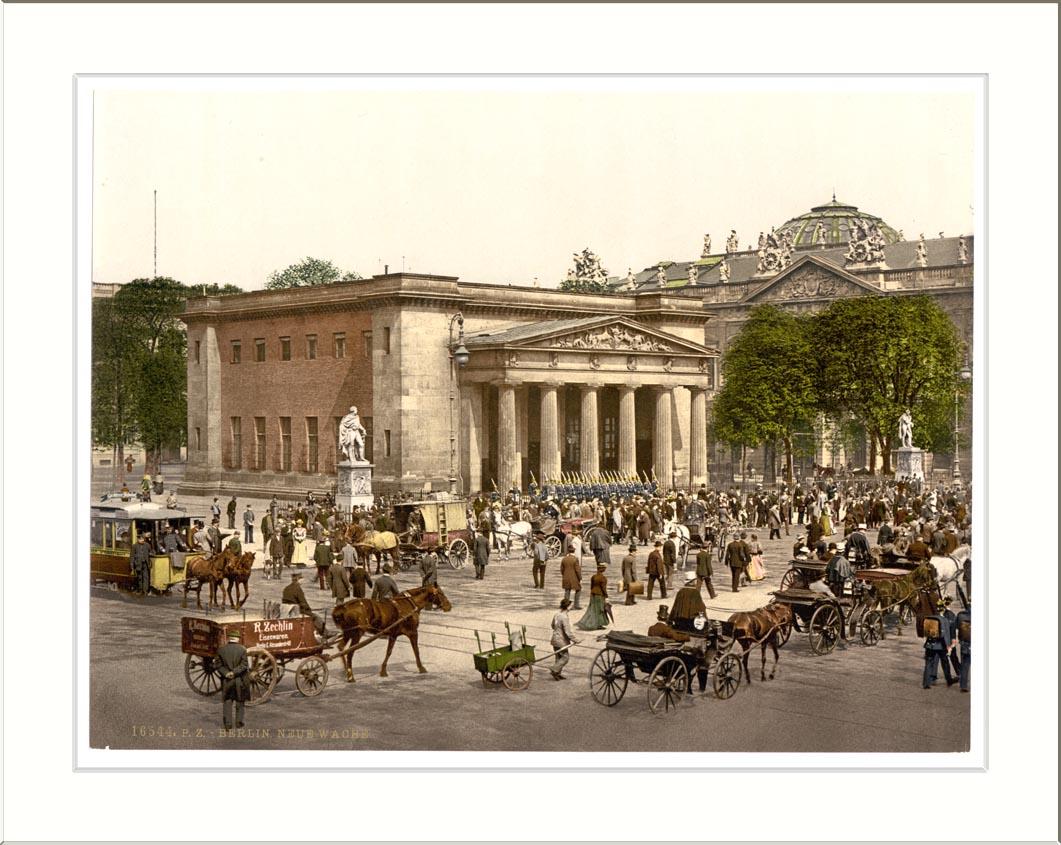
Neue Wache built – 1816
The Neue Wache, located on Unter den Linden in Berlin, was built between 1816 and 1818 by the architect Karl Friedrich Schinkel. Originally, it served as a guardhouse for the Royal Palace and as a memorial to the soldiers who fought in the Wars of Liberation against Napoleon. Its neoclassical design includes a Doric columned portico and a tympanum featuring a sculpture by Johann Gottfried Schadow of Nike, the goddess of victory, representing Prussia’s triumphs.
In 1931, following World War I and the fall of the monarchy, architect Heinrich Tessenow redesigned the interior to create a memorial for the soldiers who had died. He introduced a black granite block and an oak wreath, shifting the building’s purpose from military to remembrance. The Neue Wache suffered damage during World War II but was rebuilt in the 1950s. In 1960, it reopened under the East German government as a memorial for victims of fascism and militarism.
The interior displayed the remains of an unknown soldier and a concentration camp victim, along with an eternal flame, highlighting the human cost of war. After German reunification in 1993, the Neue Wache was rededicated as the Central Memorial of the Federal Republic of Germany for the Victims of War and Tyranny. Käthe Kollwitz’s sculpture “Mother with her Dead Son” was placed beneath the oculus, symbolizing the suffering of civilians during wartime.
Any feedback for this story?