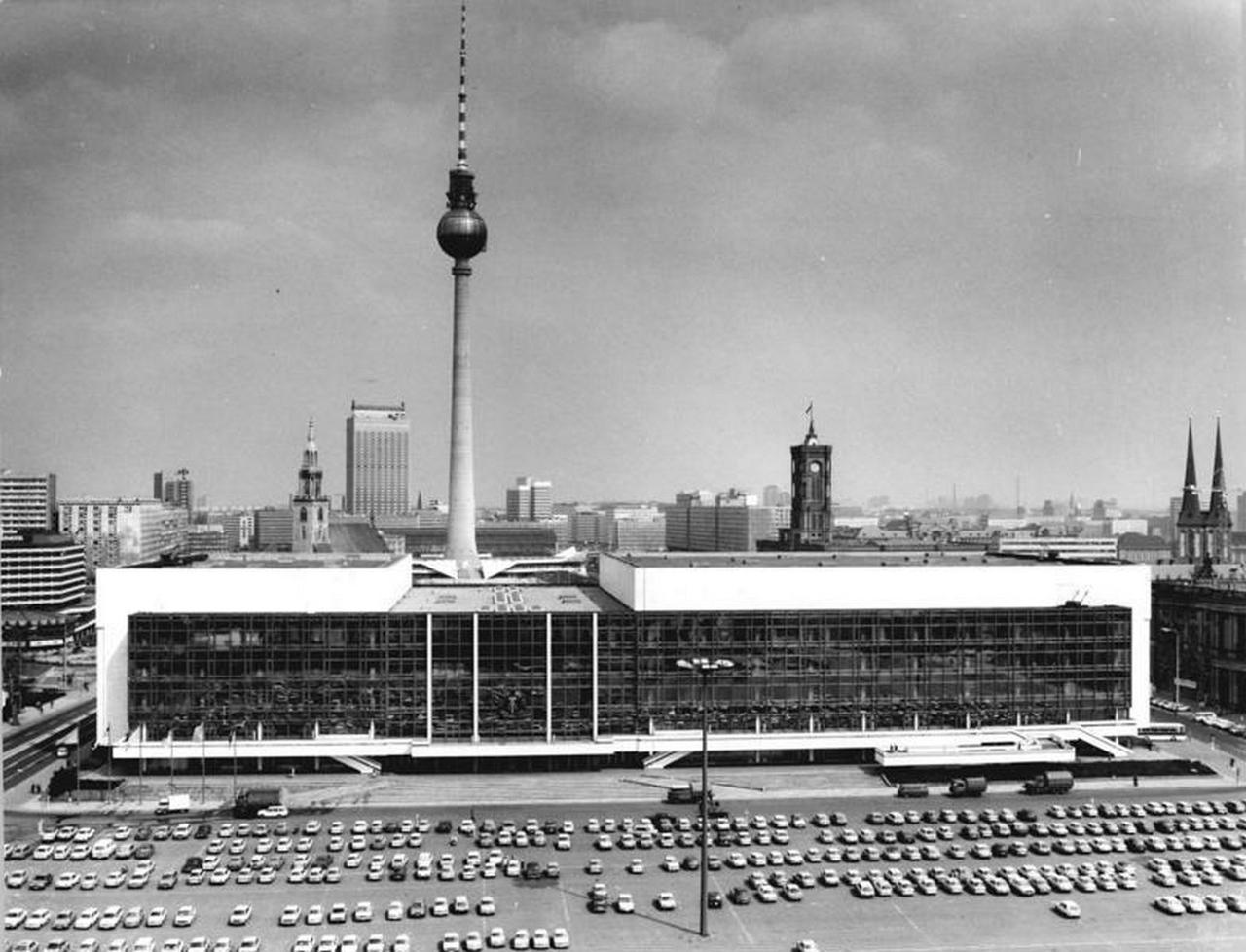
Palace of the Republic
Standing before you is the Palace of the Republic, a symbol of East Germany’s political life for over three decades. Located on Berlin’s historic Museum Island, this building served as the seat of the East German parliament, the Volkskammer, from its opening in nineteen seventy-six until German reunification in nineteen ninety. The Palace replaced the old Berlin City Palace, which was heavily damaged during World War II and later demolished by the East German government. Construction of the Palace of the Republic began in nineteen seventythree and took nearly three years to complete.
Designed in a modernist style, the building reflected the socialist ideals of the German Democratic Republic (GDR). Inside, the Palace was not only a parliament building but also a cultural hub. It housed theaters, restaurants, and art galleries, making it a center for social and political life. One notable feature was its extensive use of bronze and steel, materials intended to showcase the strength and modernity of the socialist state. However, the Palace was also controversial due to the discovery of asbestos in its structure, which eventually led to its closure in nineteen ninety.
Following reunification, debates raged about its fate—whether to preserve the building or demolish it and rebuild the historic City Palace. In twenty ten, demolition began, and by twenty thirteen, the Palace of the Republic was completely removed. Today, the Berlin City Palace has been reconstructed on the same site, aiming to blend historical architecture with modern cultural use.
Any feedback for this story?