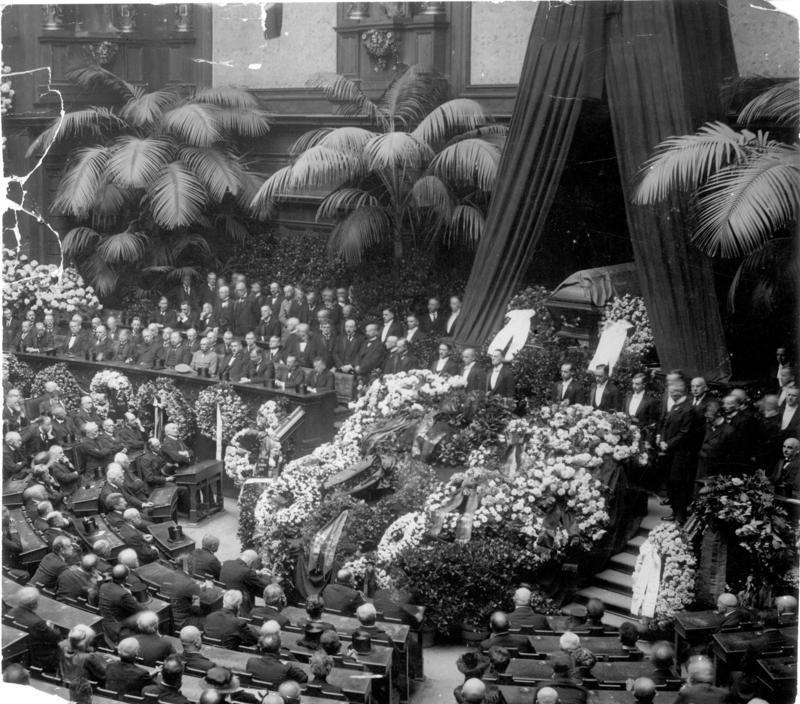
Rathenau assassinated – 1922
On the morning of June 24, 1922, Berlin’s streets were calm as Walther Rathenau, Germany’s Foreign Minister, left his home in Grunewald to head to the Foreign Office on Wilhelmstraße. Rathenau, known for his diplomatic work and efforts to stabilize Germany after the First World War, followed the same route almost every day in his open-top car. As his car reached Königsallee, another vehicle overtook him. From the back seat, Erwin Kern opened fire with a submachine gun, while Hermann Fischer threw a hand grenade into Rathenau’s car.
The attack was sudden and deadly, and Rathenau was mortally wounded. The assailants, members of the ultra-nationalist Organisation Consul, escaped quickly. Today, a memorial stone marks the exact spot where he fell. Rathenau’s assassination was part of a larger campaign by right-wing extremists who opposed his policies, especially his diplomatic engagement with Soviet Russia through the Treaty of Rapallo and his work to strengthen Germany’s post-war economy. To them, Rathenau represented the weaknesses of the Weimar Republic and was seen as a traitor.
The nation reacted with shock. Millions of Germans mourned Rathenau in the streets, and public outrage led the government to pass the Law for the Protection of the Republic, aimed at curbing political violence and protecting democratic institutions. In October 1922, the trial of those involved revealed some of the plot. Ernst Werner Techow, who drove the getaway car, was convicted as an accessory to murder but avoided the death penalty by claiming duress.
Other conspirators received various sentences, though the full extent of Organisation Consul’s network remained partly hidden. Rathenau’s funeral drew two million people, making it one of the largest public gatherings in Germany at that time. While the Weimar Republic continued to face political challenges, Rathenau’s legacy remained a reminder of the fragility of democracy and the threat posed by extremist violence.
Decades later, even after the Nazis tried to erase his memory, memorials in Berlin, especially the stone on Königsallee, still honor him. They serve as a solemn reminder of Rathenau’s life and the enduring struggle to defend democratic values.
Any feedback for this story?