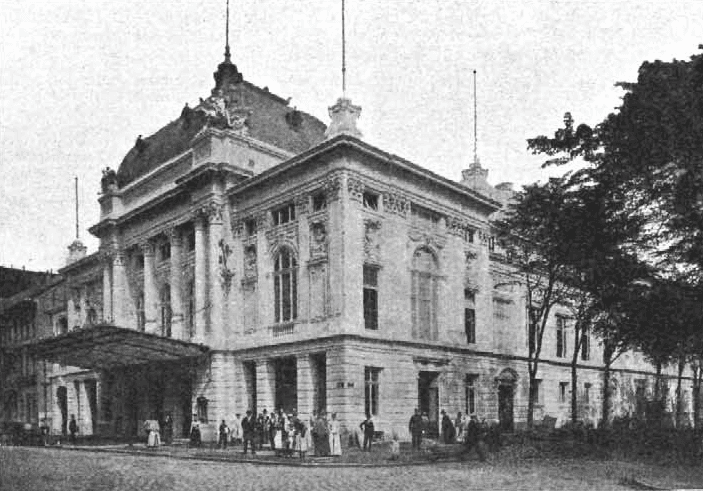
Schauspielhaus opens – 1821
The Gendarmenmarkt square in Berlin is home to one of the city’s most striking historical buildings. In 1821, the Schauspielhaus opened here, designed by the architect Karl Friedrich Schinkel. It was built to replace the Nationaltheater, which had been destroyed by fire in 1817. The neoclassical design reflects Schinkel’s admiration for ancient Greek architecture, complete with a grand staircase and a statue of Apollo crowning the roof.
The first performance took place on May 26, 1821, with Goethe’s play Iphigenia in Tauris. A few weeks later, Carl Maria von Weber’s opera Der Freischütz premiered, marking an important moment in German music history. The Schauspielhaus soon became a cultural center, hosting performances by famous artists such as Niccolò Paganini, Franz Liszt, Felix Mendelssohn, and the Berlin premiere of Beethoven’s Ninth Symphony in 1826. The building was not only a cultural landmark but also played a part in politics.
During the 1848 Revolution, the Schauspielhaus served as a meeting place for the Prussian National Assembly, showing its importance beyond the arts. World War II brought severe damage. In 1945, a fire destroyed the building almost completely. It was not until 1984 that it was rebuilt and reopened as the Konzerthaus Berlin, continuing its tradition as a leading venue for concerts and cultural events.
Any feedback for this story?