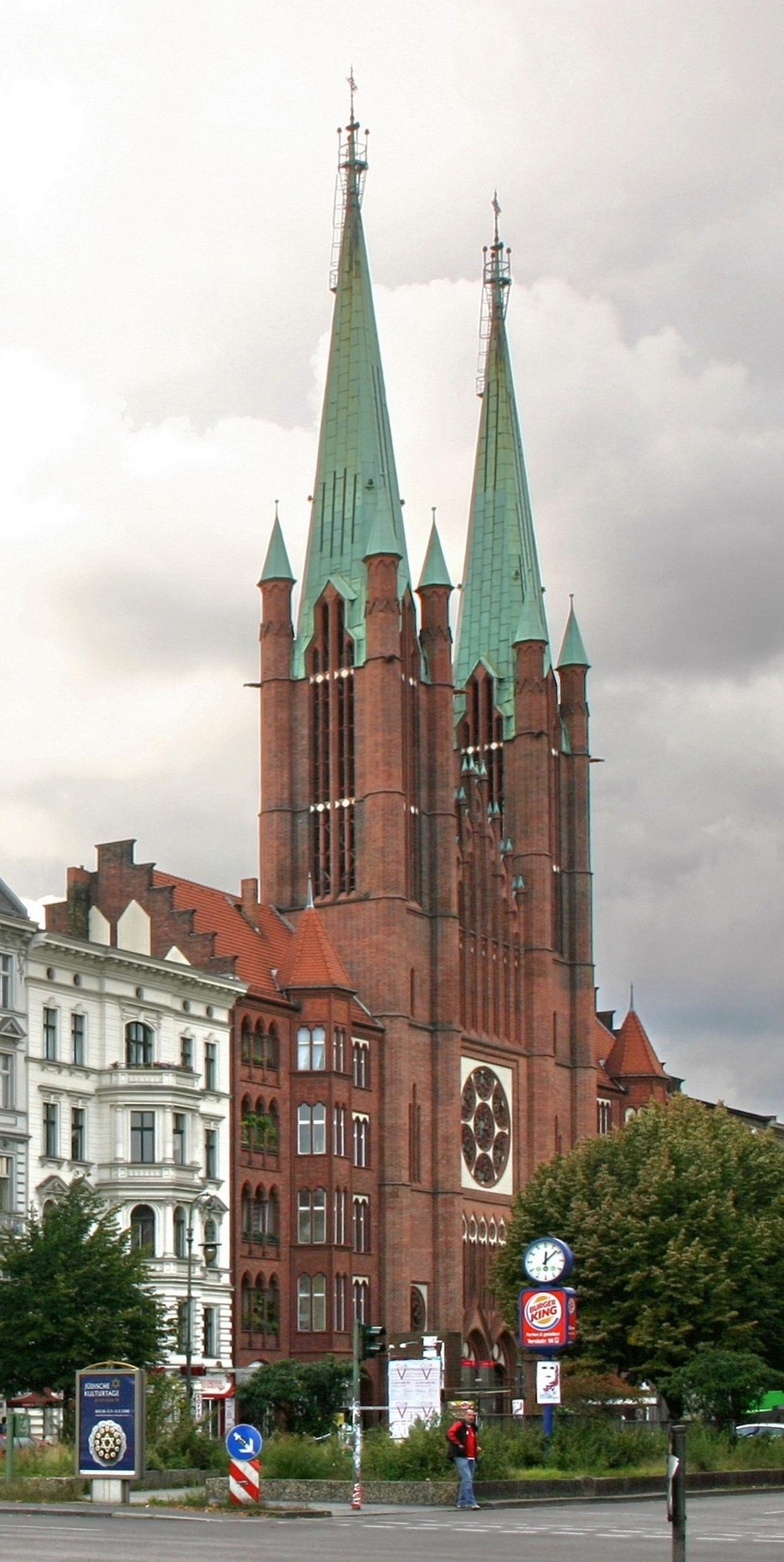
St. Boniface Church
In the heart of Berlin’s Kreuzberg district, the Sint-Bonifatius Church stands as a symbol of resilience and architectural splendor. Designed by Max Hasak, this neo-Gothic church was built between 1906 and 1907 to serve the growing Catholic community. The first stone was laid on the feast day of Saint Boniface in 1906, and the church was consecrated the following year. Its exterior is defined by twin towers and a red brick façade, inspired by late Gothic architecture but with a modern touch.
Surrounding residential blocks, constructed at the same time, provided steady income for the church’s upkeep. Inside, high vaulted ceilings and a minimalistic design create an atmosphere of calm. The original stained-glass windows were destroyed during World War II. In the 1960s, Paul Brandenburg redesigned the interior, adding a blue mural behind the altar by artist Fred Thieler, which brought a contemporary element.
The church was badly damaged by fire during the war but reopened as early as 1946 to serve its parish. In later decades, several renovations preserved the structure, culminating in a major restoration project from 2004 to 2006, including roof repairs.
Any feedback for this story?