The Aftermath
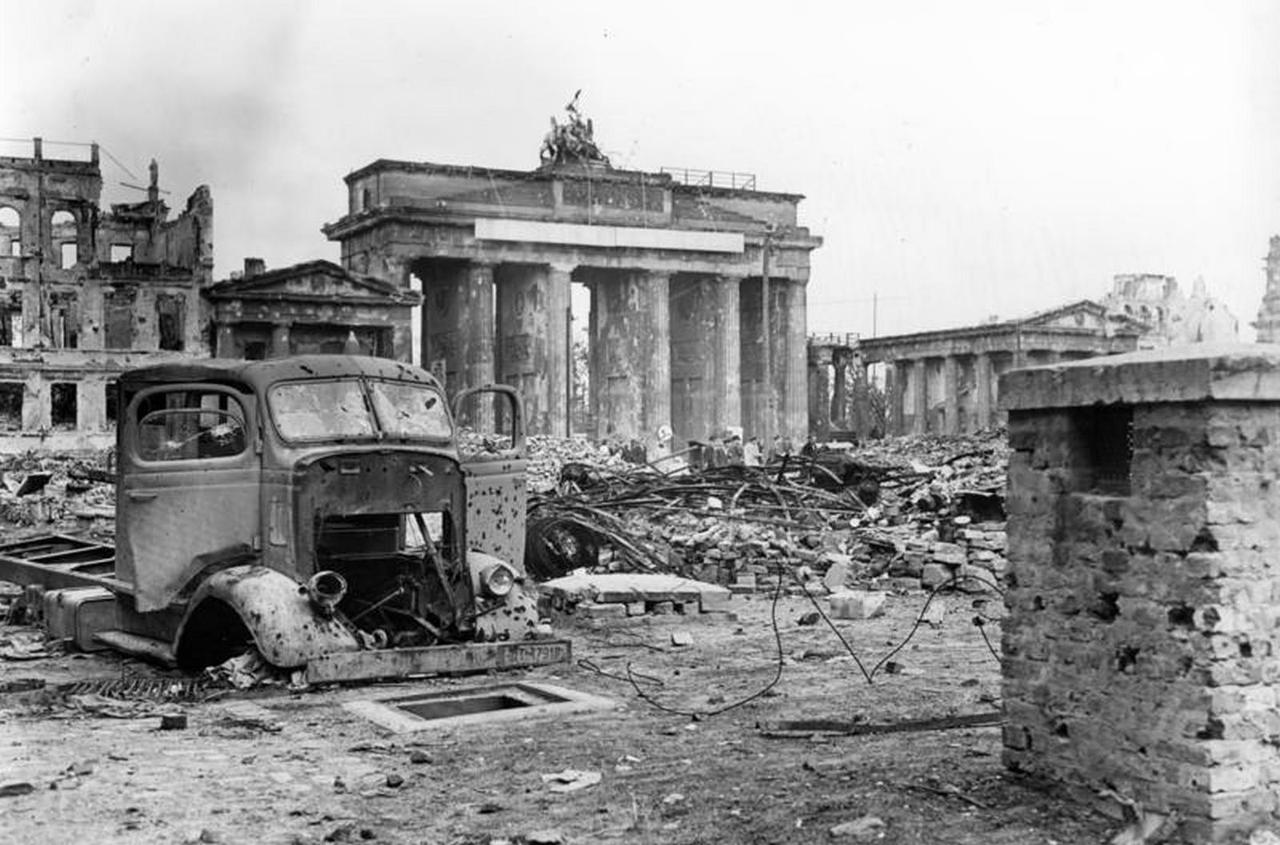
At this exact location, the city of Berlin began a long and difficult journey to recover after the Battle of Berlin in 1945. The fierce fighting, which ended the war in Europe, left much of the city devastated, with entire neighborhoods reduced to rubble. What followed was a complex period of rebuilding that would shape Berlin’s identity for decades. After the German surrender, Berlin was divided into four zones, each controlled by one of the Allied powers: the United States, the Soviet Union, the United Kingdom, and France. This division was not only geographical but soon became political, setting the stage for the Cold War.
The eastern part of the city fell under Soviet control and later became East Berlin, while the western parts were governed by the Western Allies, forming West Berlin. The damage was immense. The Reichstag building, once the seat of German parliament, was so badly damaged that it remained in ruins for decades before its eventual restoration. The Brandenburg Gate, which once symbolized unity, stood isolated near the new border dividing the city. One surprising detail is how quickly makeshift solutions appeared to address the housing crisis. In East Berlin, workers built large prefabricated apartment blocks known as Plattenbau, designed for speed and efficiency.
Meanwhile, West Berlin became a showcase of Western aid and innovation, benefiting from the Marshall Plan, which helped fuel reconstruction and economic revival. Some sites still preserve traces of the division and destruction. Checkpoint Charlie was one of the most famous crossing points between East and West and witnessed tense moments during the Cold War. The Berlin Wall, constructed in 1961, cut through streets, separating families and communities until its fall in 1989. Parts of it remain visible as a reminder of a divided past. Memorials like the Soviet War Memorial in Treptower Park honor those who died in the battle, standing as solemn reminders of the heavy human cost. The city’s transformation was not just about rebuilding bricks and mortar but also about confronting its history, memory, and the realities of division.
Any feedback for this story?