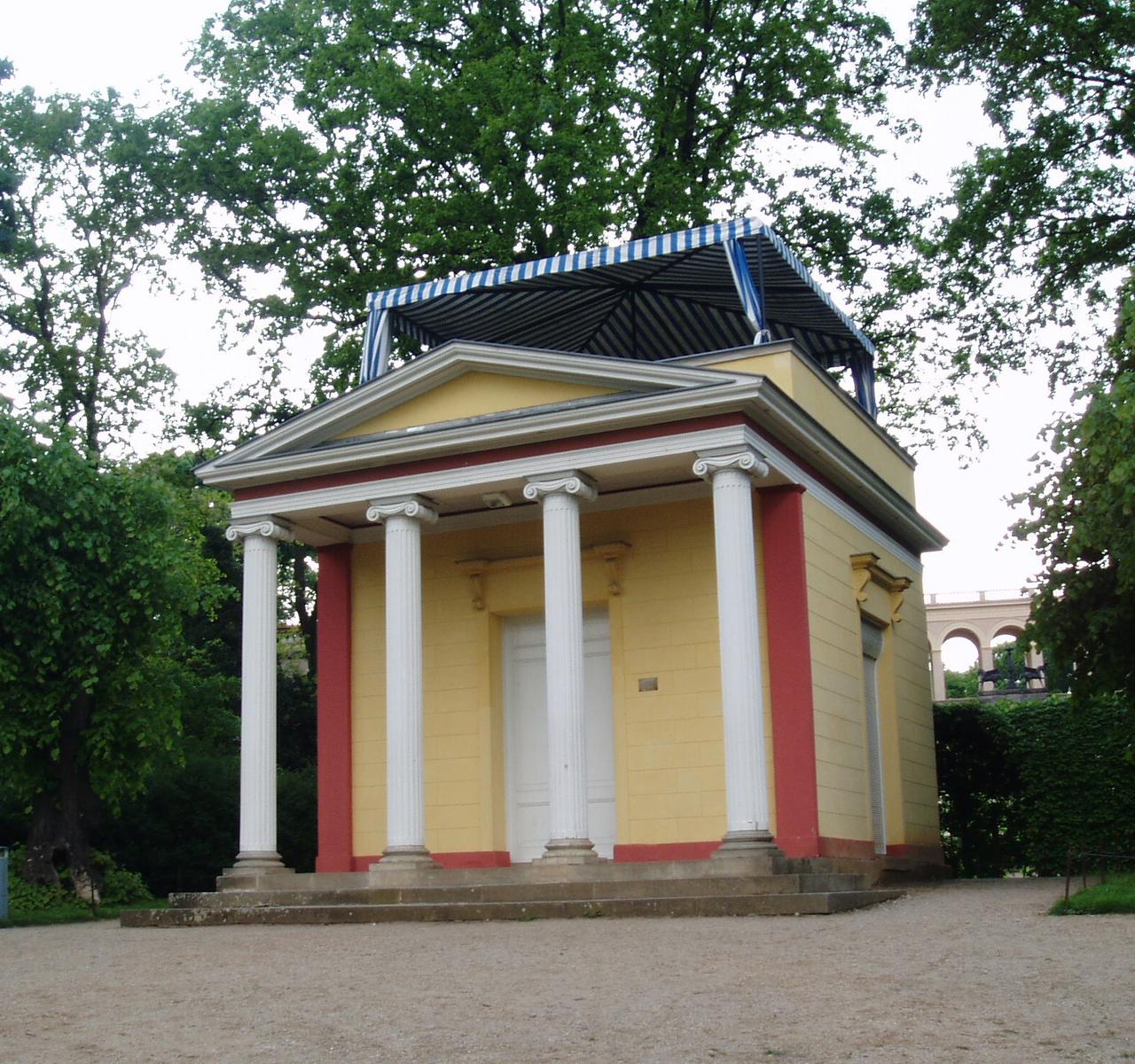
The Temple of Ponoma
Nestled on the southern slope of Potsdam’s Pfingstberg, the Temple of Pomona offers a captivating glimpse into history. It was the very first architectural work of Karl Friedrich Schinkel, later a key figure in neoclassicism. Commissioned in 1801 by Prussian Privy Councilor Carl Ludwig von Oesfeld as a gift for his wife, the temple honored Pomona, the Roman goddess of fruit. Von Oesfeld’s original vineyard temple was demolished, and Schinkel created a new design in the form of a Greek temple, inspired by the Erechtheion on Athens’ Acropolis.
Its blue-and-white striped tent roof was added later to echo the interiors of other royal palaces like Charlottenhof. In 1847, King Frederick William IV’s plans for the Belvedere nearly led to the temple’s demolition. His death, however, spared it, and Peter Joseph Lenné integrated the temple into the palace gardens, connecting it with the Belvedere through a semicircular arcade. Restored for the 1936 Olympic Games, the temple survived World War II but fell into disrepair afterward due to its proximity to Soviet Camp No. 7 and the inner-German border.
In the 1980s, rediscovery efforts began, and after reunification the Förderverein Pfingstberg Potsdam e.V., supported by the Hermann Reemtsma Foundation, spearheaded its reconstruction. From 1992 to 1993 it was meticulously restored. Today, the Temple of Pomona is not just an architectural gem but also a cultural hub, hosting exhibitions, storytelling sessions, and private events between Easter and October, ensuring Schinkel’s neoclassical masterpiece endures.
Any feedback for this story?