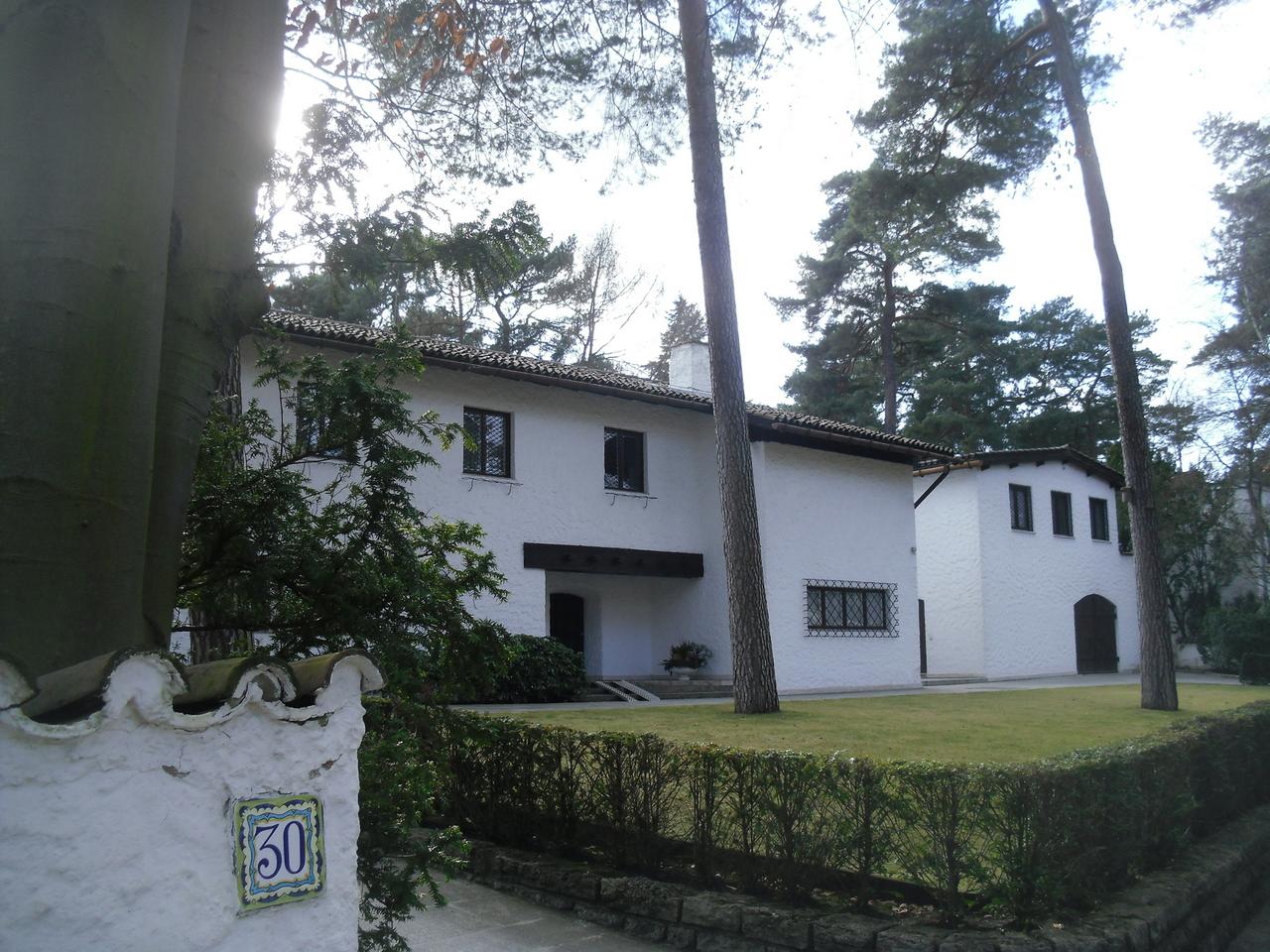
Villa Riefenstahl
Look across to the cream-coloured façade on Heydenstraße, and you’re seeing a house that was once at the centre of both architectural experimentation and a turbulent chapter in Berlin’s history. This is Villa Riefenstahl, built in 1935–1936 for filmmaker Leni Riefenstahl, whose career was tied to the Nazi era. The land once belonged to the wealthy Jewish Wertheim family, famous for their department stores. Under pressure from the regime, they were forced to sell their property—an early example of how political shifts reshaped private lives and neighbourhoods. Riefenstahl didn’t simply buy a ready-made home; she co-designed it with architects Ernst Petersen and Hans Ostler.
From the street, the house reflects Alpine influences—a low, sweeping roof, deep eaves, and wooden shutters—features rarely found in Berlin at the time. But step around to the garden side and the mood changes: modern, horizontal windows, a glass-walled entrance hall, and a long upper band of windows and shutters that blur the line between indoors and out. Inside, the layout served both comfort and work. A bright living room opened onto the terrace and garden, while a small projection room turned part of the home into a private cinema. There was a darkroom in the basement, and Riefenstahl’s archive and workspace were integrated into the design—unusual for private houses then.
The garden, designed by landscape architect Heinrich Wiepking-Jürgensmann, was another quiet departure from Berlin norms. Instead of a high wall or dense plantings at the front, it had an open lawn with scattered trees, blending seamlessly into the nearby Grunewald. This choice made the villa feel connected to its surroundings rather than enclosed from them. Magazines of the era, including Das schöne Heim and Berliner Illustrirte Zeitung, showcased the villa—sometimes with images of Riefenstahl entertaining guests like Hitler and Goebbels on the terrace. After the war, she sold the property, and later owners made additions in the 1950s and 1970s. Despite these changes, its unusual mix of Alpine tradition and modernist openness still sets it apart on the quiet street today.
Any feedback for this story?