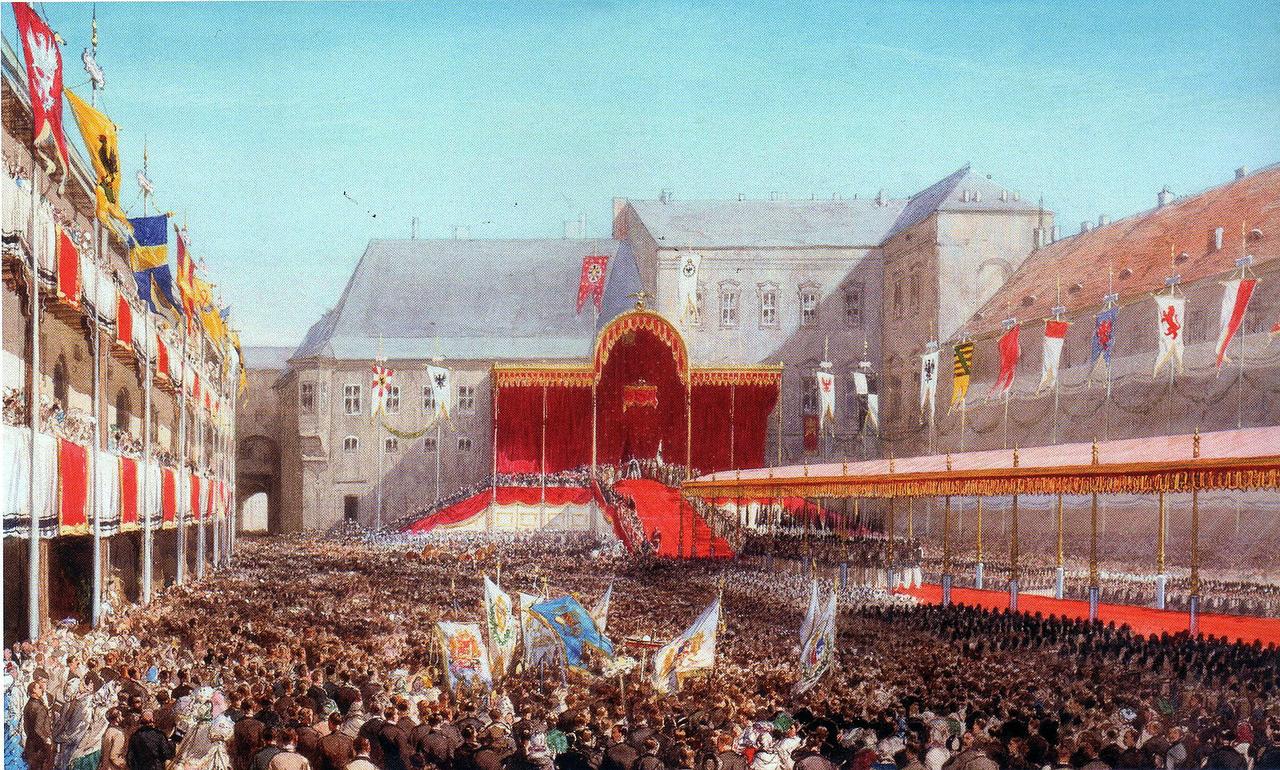
Wilhelm I crowned – 1871
In January 1871, Berlin was part of a turning point in German history that would unite its many states under one crown. On 18 January 1871, in the Hall of Mirrors at the Palace of Versailles, King Wilhelm I of Prussia was proclaimed German Emperor. The date was chosen to match the coronation of the first Prussian king in 1701, symbolising both tradition and a new beginning. The road to unification was neither quick nor simple. It came after years of wars and political agreements, led by the careful strategy of Otto von Bismarck.
The November Treaties of 1870 brought Bavaria, Baden, Hesse, and Württemberg into the empire while allowing them to keep certain rights, such as their own armies and tax systems. Wilhelm I himself was not eager to take the title. He worried it would overshadow his position as King of Prussia. He even preferred the title “Emperor of Germany,” but Bismarck advised against it to avoid upsetting the other German rulers. The coronation ceremony was more modest than many might expect. Versailles, chosen for its political symbolism, had recently been used as a military hospital.
A field altar replaced the throne, and the service included speeches and prayers rather than grand displays. One small but notable fact is that no actual imperial crown was made. A model was designed based on the crown of the Holy Roman Empire and kept in Berlin’s Hohenzollern museum, but it disappeared during the Second World War. Instead, the crown design was used only in coats of arms and imperial emblems until 1918.
Any feedback for this story?