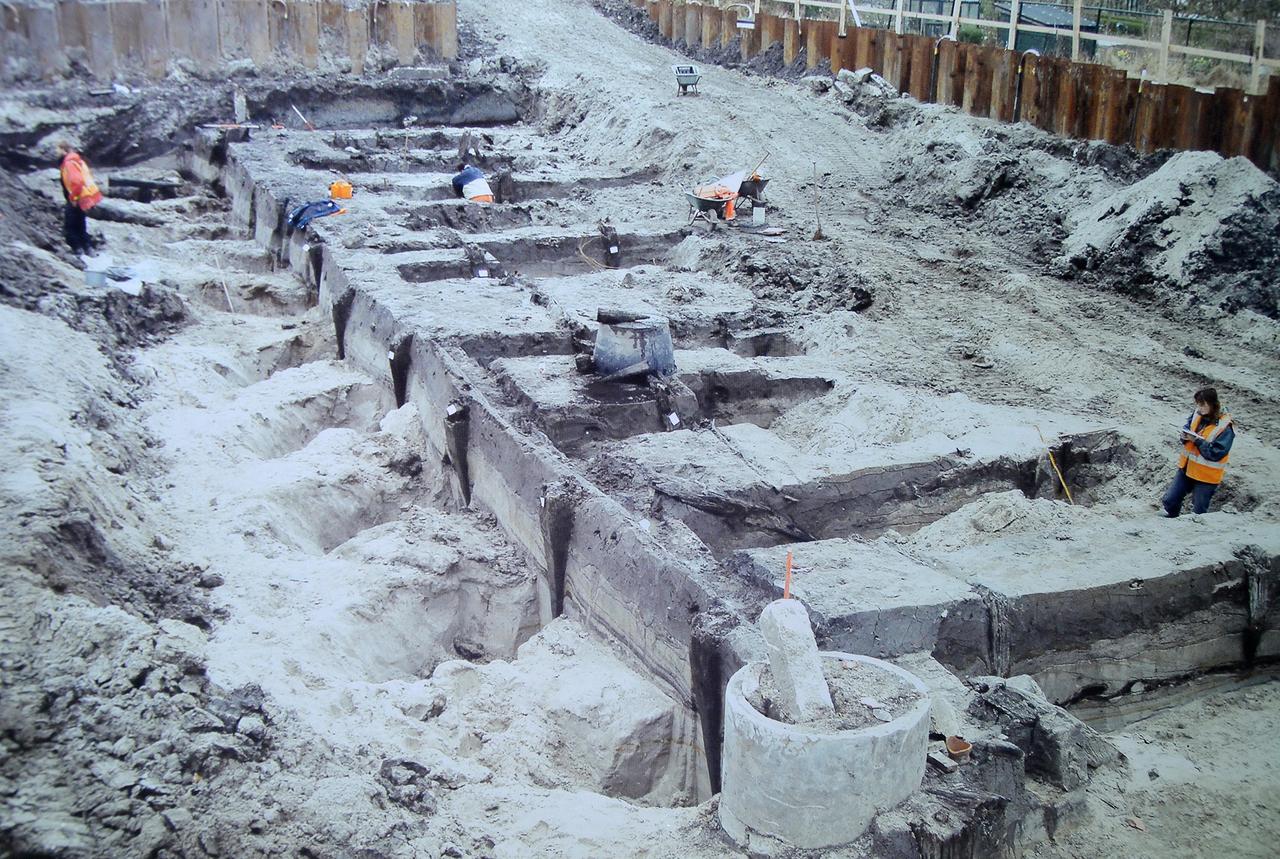
Forum Hadriani
Imagine a day in the distant past, when today’s Voorburg was home to the bustling Roman town of Forum Hadriani. Set along a smartly constructed waterway and surrounded by fertile fields, it was a place where artisans, merchants, and officials lived their daily lives in the shadow of an empire.
Entering the town via one of its well-paved roads, visitors would immediately notice its organized layout. Straight streets in a grid pattern led to the central square: the forum. Here, the chatter of traders, travelers sharing distant tales, and townsfolk doing their shopping filled the air. In one corner stood a temple, where incense smoke drifted upwards as offerings were made to household and city gods.
One of the most vibrant spots was the bathhouse—an essential part of any Roman town. People came not only to wash, but to relax, talk, and share ideas. The hiss of warm water mingled with laughter and conversation in a space where social class briefly faded away.
Forum Hadriani thrived thanks to the Corbulo Canal, built by the Romans to link the Old Rhine with the Meuse estuary. It served as a vital trade route, with boats carrying goods like wine, pottery, and grain along its shimmering waters.
Though the town had only about 1,500 residents, it radiated refinement and connection. Local farmers sold their harvests alongside goods from the distant south. Modest in size, Forum Hadriani played a key role in maintaining Roman presence in the region.
Any feedback for this story?