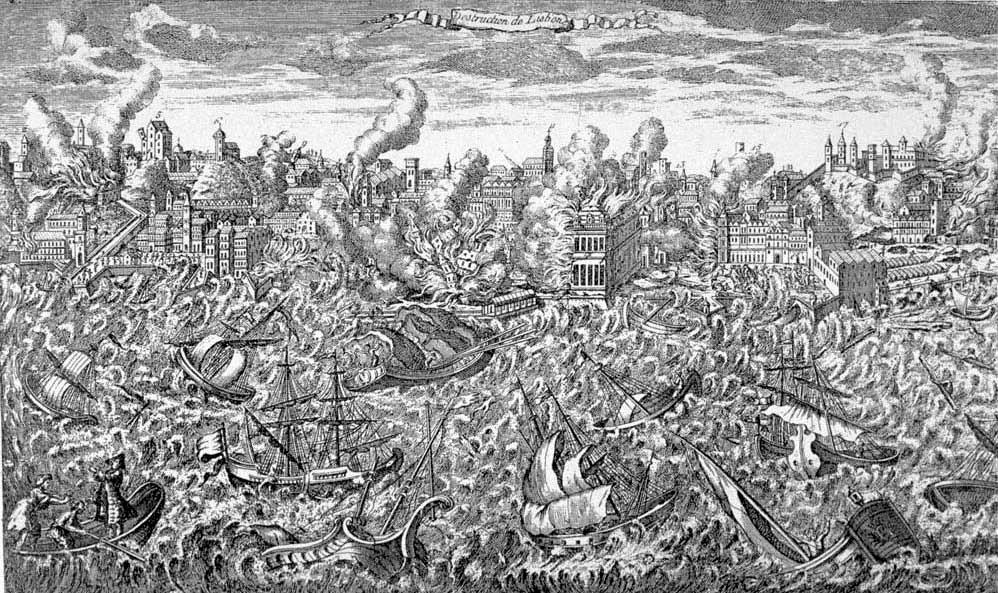
The Great Quake
On the morning of November 1, 1755, at 9:40 AM, the ground beneath the Baixa district began to shake violently. It was All Saints' Day, and every church along the Tagus riverside was packed with worshippers when one of Europe's most powerful earthquakes struck with a magnitude between 8.5 and 9.0. The tremors lasted nearly six minutes, creating fissures five meters wide that ripped through streets and toppled buildings.
Terrified survivors rushed to the open docks by the river, thinking they had found safety. But 40 minutes later, the sea suddenly pulled back, revealing shipwrecks and treasure in the mud. Then a massive tsunami roared up the Tagus with waves six meters high, drowning thousands who had gathered at the waterfront. The candles lit for the holy day became deadly. As churches and homes collapsed, flames from the overturned candles spread rapidly.
Fires consumed the Royal Hospital in Rossio square, burning hundreds of patients alive. The inferno raged for five days, destroying the Royal Palace, the grand Opera House that had opened just eight months earlier, and the royal library containing 70,000 volumes. Between 60,000 and 100,000 people perished. The Marquis of Pombal led the complete reconstruction, replacing narrow medieval lanes with the wide geometric avenues that shape the Baixa Pombalina district.
Any feedback for this story?