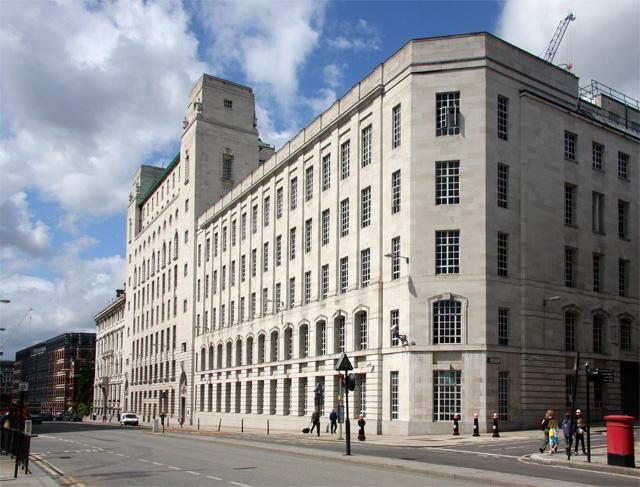
Faraday Building & General Post Office
The Faraday Building, located on Queen Victoria Street in the City of London, is a remarkable structure with a storied history. Originally constructed as a sorting center for the General Post Office, the building was later transformed into a telephone exchange in 1902, marking its evolution alongside technological advancements in communication. The building served as an essential hub for Britain's state-run postal and telephony services, which eventually evolved into what we know today as British Telecom and Royal Mail.
In 1933, a significant expansion added an additional wing to the west side of the building, effectively doubling its floor space. This extension stirred controversy at the time, as the building's tall office tower with its ornate turrets obstructed views of the iconic St. Paul’s Cathedral from the River Thames. This sparked a public outcry that eventually led to legislation limiting the height of new buildings in central London to preserve the view of the cathedral, a law that continues to influence the city’s skyline to this day. Named after the renowned scientist Michael Faraday, the building pays homage to his groundbreaking work in the fields of electricity and magnetism. Faraday’s contributions to science include his discovery of electromagnetic induction and the principles behind the electric motor and transformer.
He is also famous for the Faraday cage, a structure made of conductive material that blocks external static and non-static electric fields. This principle explains why cell phones sometimes lose signal inside elevators, as the conductive walls of the elevator act like a Faraday cage, blocking electromagnetic signals. The Faraday Building stands as a testament to both architectural innovation and the scientific legacy of its namesake. Its transformation from a postal sorting facility to a central telephone exchange highlights the technological progress of the 20th century.
The controversies surrounding its expansion underscore the delicate balance between urban development and heritage preservation in one of the world's most historically significant cities. Today, the building serves as a reminder of London's rich history and the enduring impact of Michael Faraday's scientific discoveries.
Any feedback for this story?