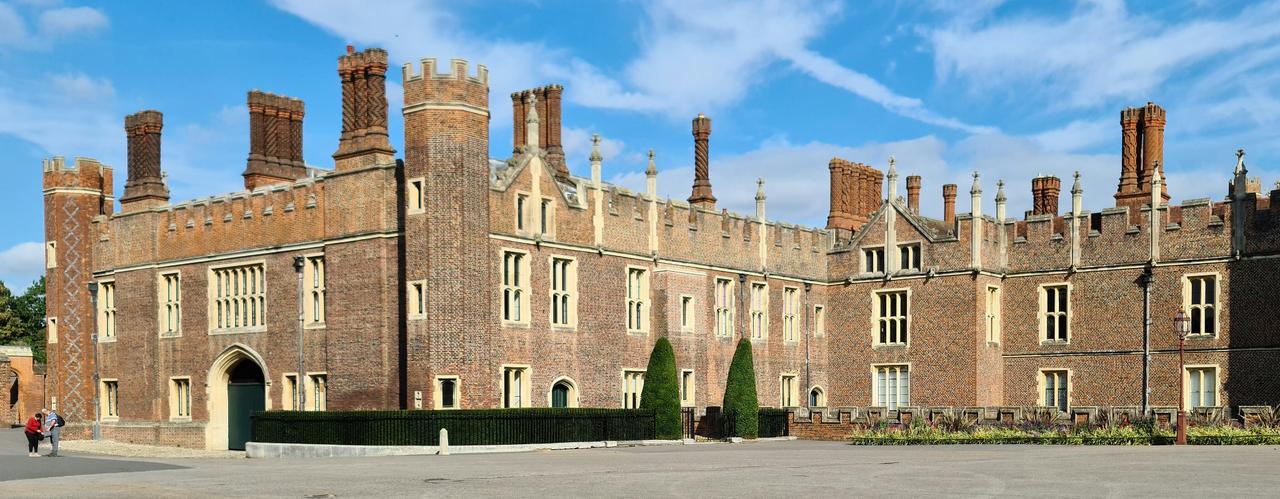
Hampton Court Palace
Hampton Court Palace, located on the banks of the River Thames, is a remarkable blend of architectural styles that reflects England’s rich history. Originally built during the Tudor era, the palace became a significant refuge for William III of Orange and his wife, Mary II, who ascended the English throne in 1689 following the Glorious Revolution. As the Dutch Stadtholder and King of England, William commissioned the renowned architect Christopher Wren to remodel Hampton Court, aiming to rival the grandeur of France’s Versailles.
Wren’s renovation was a monumental task, with parts of the Tudor structure being torn down to make way for a new Baroque wing. The challenge was immense: the palace had to combine opulence with security. William and Mary especially valued Hampton Court for its remote location, far from the bustle of London and safely away from political threats, such as supporters of James Stuart, who sought to undermine their rule.
Despite the ambitious plans, construction came to an abrupt halt after Mary’s death in 1694. William lost interest in the project, leaving the palace in a unique architectural state. One part retains its Tudor style, while another section, influenced by Wren’s work, showcases the Baroque design, giving the palace its distinctive character. By 1760, Hampton Court was no longer used as a royal residence, and in the 19th century, Queen Victoria decided to open it to the public, transforming it into a museum. Today, Hampton Court Palace is one of England’s most important historical sites, where visitors can explore its magnificent gardens and experience the remnants of its grand and turbulent past.
Any feedback for this story?