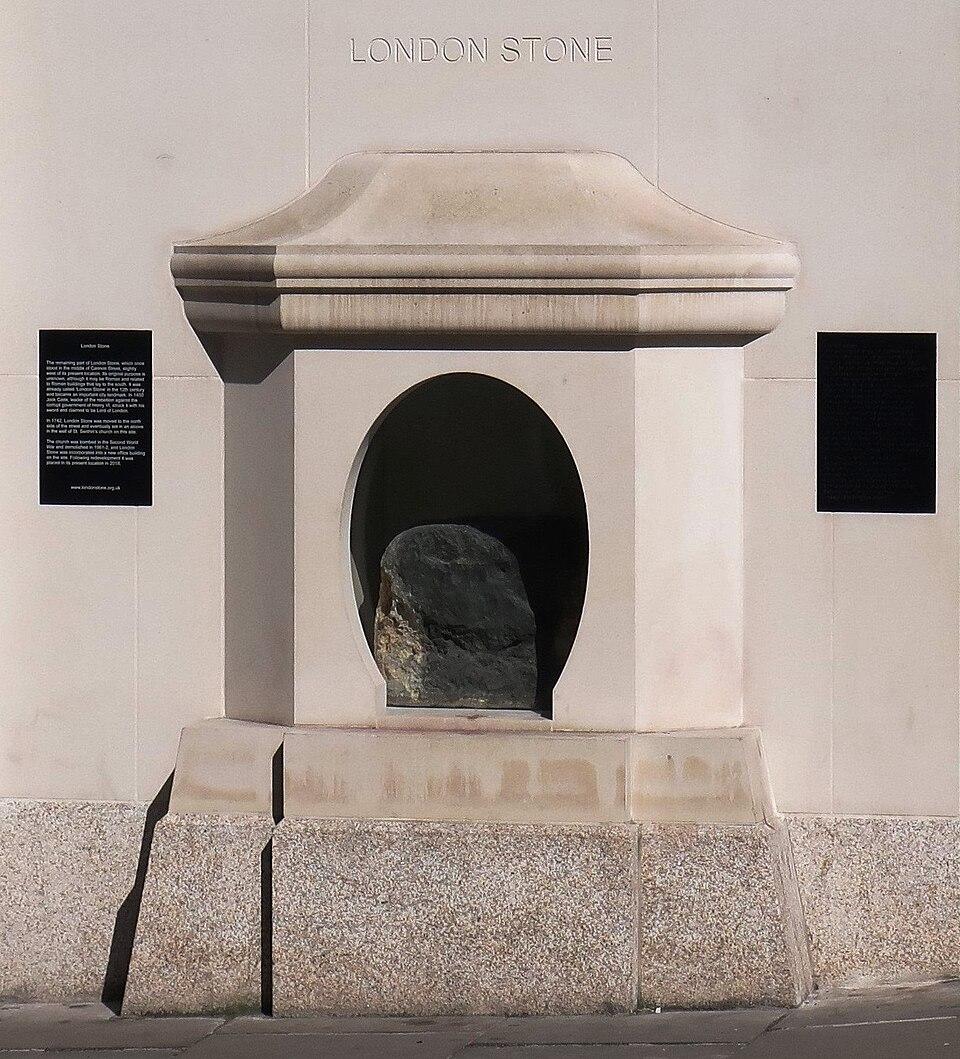
London Stone
The stone you're looking at right now is older than almost anything else in this city. It sits quietly in its Portland stone casing at 111 Cannon Street, easy to walk past without a second glance, yet it has been a landmark here since at least the year 1100, and possibly much longer.
No one knows exactly why it was placed here. The most convincing theory, favored by modern archaeologists, is that it formed part of the entrance to a large Roman administrative building that once stood nearby, possibly the palace of the Roman governor of Britain. That would make it a relic of Londinium itself, the city the Romans founded nearly two thousand years ago.
Over the centuries it attracted stories the way old stones do. In 1450, a rebel leader named Jack Cade marched into the city during an uprising against King Henry VI, struck the stone with his sword, and declared himself Lord of London. Shakespeare later dramatised the moment, turning it into one of his more chaotic crowd scenes.
The stone survived the Great Fire of 1666, German bombing in the Second World War, and even a stint hidden behind a magazine rack in a branch of WH Smith. Some landmarks demand grand treatment. This one simply endures.
Any feedback for this story?