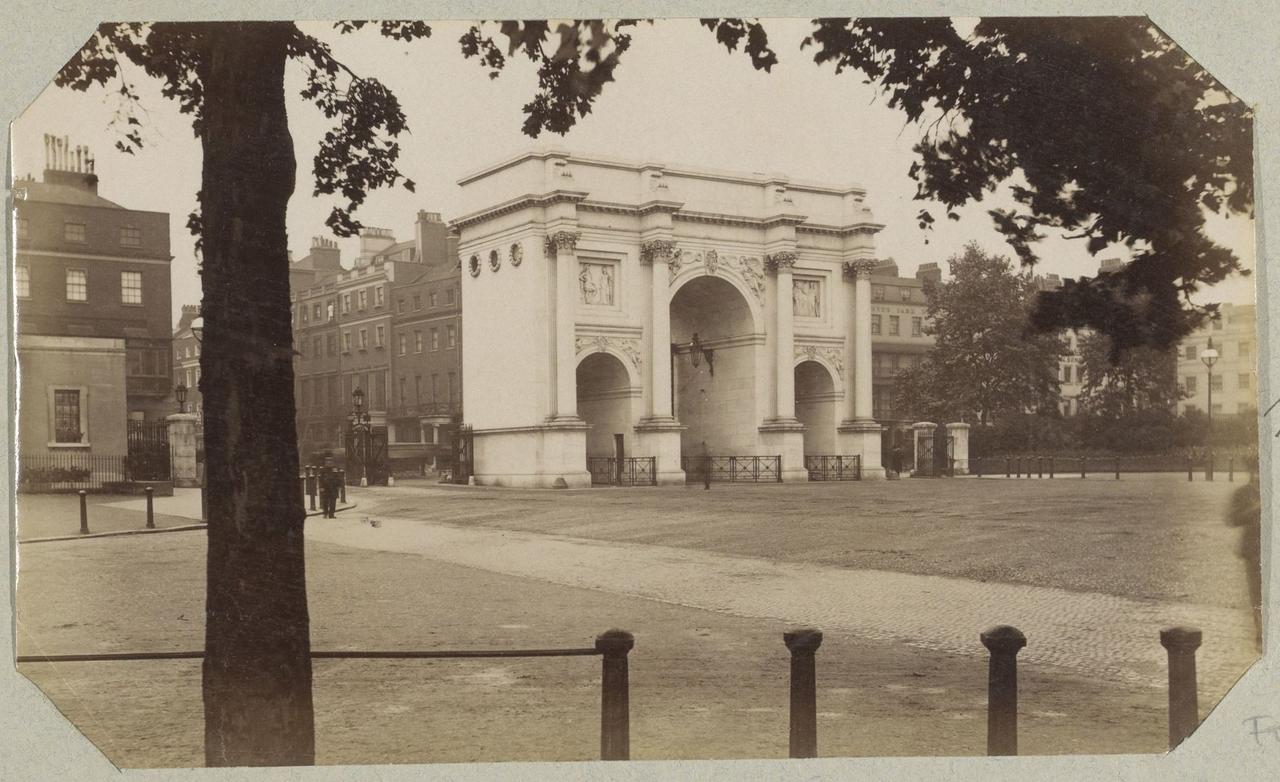
Marble Arch
Designed as a majestic entrance to Buckingham Palace, Marble Arch was created in 1828 by architect John Nash, who envisioned a grand gateway inspired by Rome’s Arch of Constantine and Paris’s Arc de Triomphe du Carrousel. Built from pristine white marble sourced from Seravezza, Tuscany, the arch was adorned with intricate details meant to reflect King George IV’s love for French neoclassicism. However, the high costs of the palace renovation eventually led to Nash’s dismissal from the project in 1829, and Marble Arch found itself without a purpose as a formal entrance.
In 1851, the arch was moved to its current location at the northern edge of Hyde Park, near Speakers’ Corner. Though no longer positioned as the palace gate, it remained a symbol of royal prestige. Traditionally, only members of the royal family and the Royal Horse Artillery passed through it, and only on ceremonial occasions. Now, Marble Arch stands at a busy intersection, serving as both a historic landmark and the namesake for the nearby Underground station.
Its new location has made it a visible fixture for tourists and Londoners alike, who admire its blend of classical style and royal heritage. While it no longer marks the entrance to Buckingham Palace, Marble Arch remains a striking piece of London’s architectural legacy, bridging the grandeur of the city’s royal past with the vibrant, modern life of Hyde Park.
Any feedback for this story?