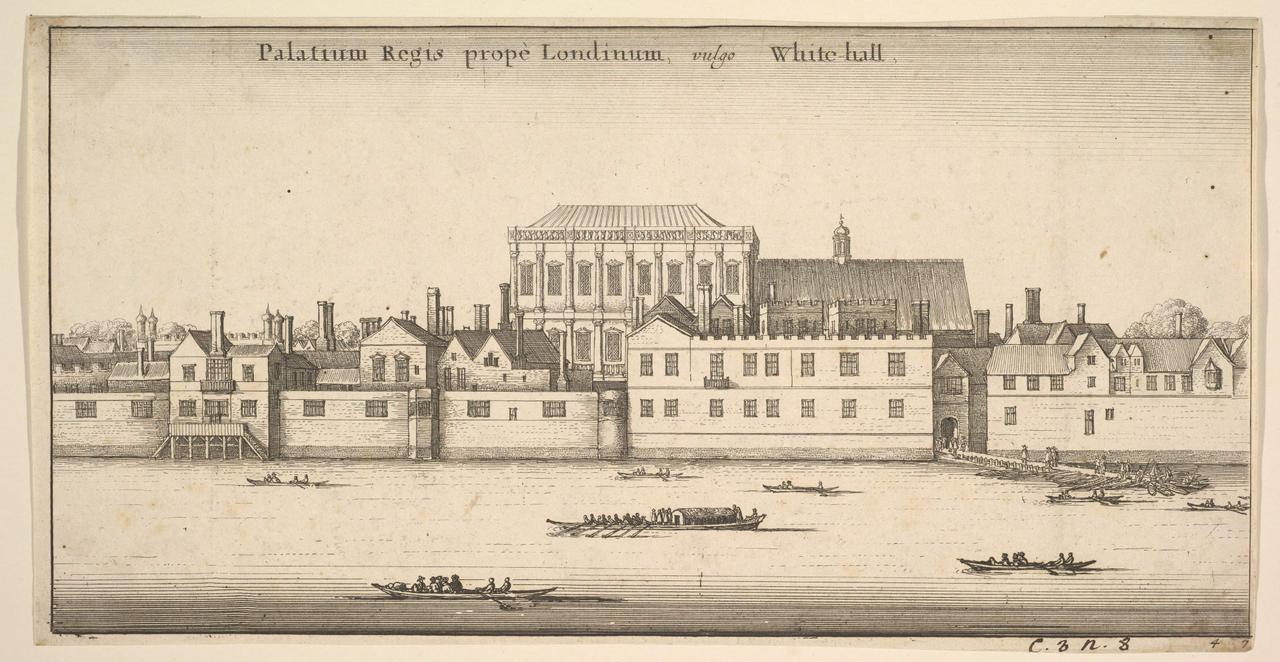
The Palace of Whitehall
The government buildings and open spaces you see between the Thames and St. James's Park were once the site of Europe's largest royal palace, a sprawling complex of 1,500 rooms covering 23 acres. The Palace of Whitehall was the beating heart of English royal power for nearly two centuries, and almost nothing of it remains.
It began as York Place, a grand residence belonging to the Archbishops of York since 1245. In 1530, Henry VIII, the famously commanding Tudor king, seized it from Cardinal Wolsey, his disgraced chief minister, and transformed it into his primary palace. He built jousting arenas, cockfighting pits, tennis courts, and elaborate gardens. He married two of his six wives here and died within these walls in 1547.
The palace witnessed extraordinary history. Charles I, king of England until parliament had him tried and executed for tyranny in 1649, walked through the Banqueting House to his beheading right here on this street.
Then, on the afternoon of January 4, 1698, a servant drying linen too close to a charcoal brazier set the whole thing ablaze. The fire burned for 15 hours, destroying priceless works by Michelangelo and Holbein. Only the Banqueting House survived.
A palace that took 150 years to build was gone because of a laundry accident.
Any feedback for this story?