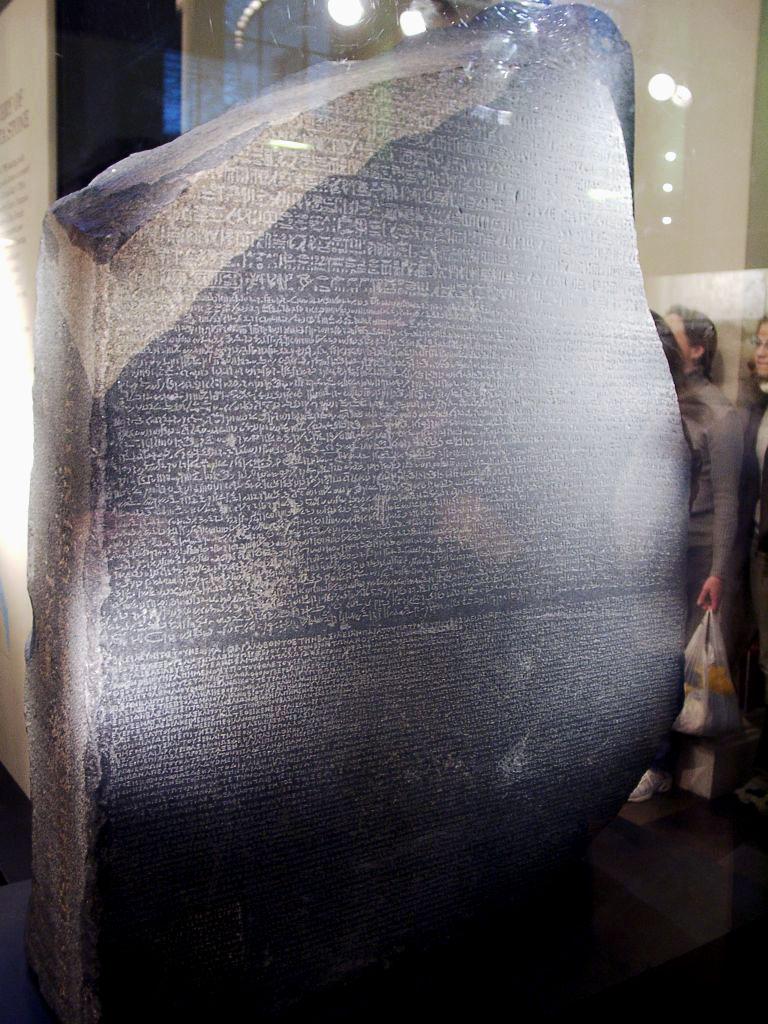
The Rosetta Stone
Inside this grand building with its iconic columns on Great Russell Street stands a dark stone fragment that changed everything we know about ancient Egypt. The Rosetta Stone is a broken slab of black granodiorite, just over a meter tall, covered with the same message carved three times in three different scripts. In July 1799, French soldiers digging foundations near the town of Rosetta in the Nile Delta discovered this ancient fragment being reused as building material. What made it extraordinary was immediately clear.
The stone displayed identical text in hieroglyphics, Demotic script, and ancient Greek. For more than 1,300 years, no one on Earth could read hieroglyphics. The mysterious symbols covering temples and monuments across Egypt had been silent since the 4th century. This stone became the key. Scholars could read ancient Greek, so by comparing all three versions of the text, they finally had a way to crack the hieroglyphic code.
When the French were defeated in Egypt in 1801, the stone became part of the peace treaty and crossed the Mediterranean. It arrived at this building in 1802. The race to decipher it captivated Europe. French scholar Jean François Champollion made the breakthrough in the 1820s, finally unlocking 3,000 years of Egyptian civilization. The text itself is a decree from 196 BC praising the 13 year old Pharaoh Ptolemy V.
Any feedback for this story?