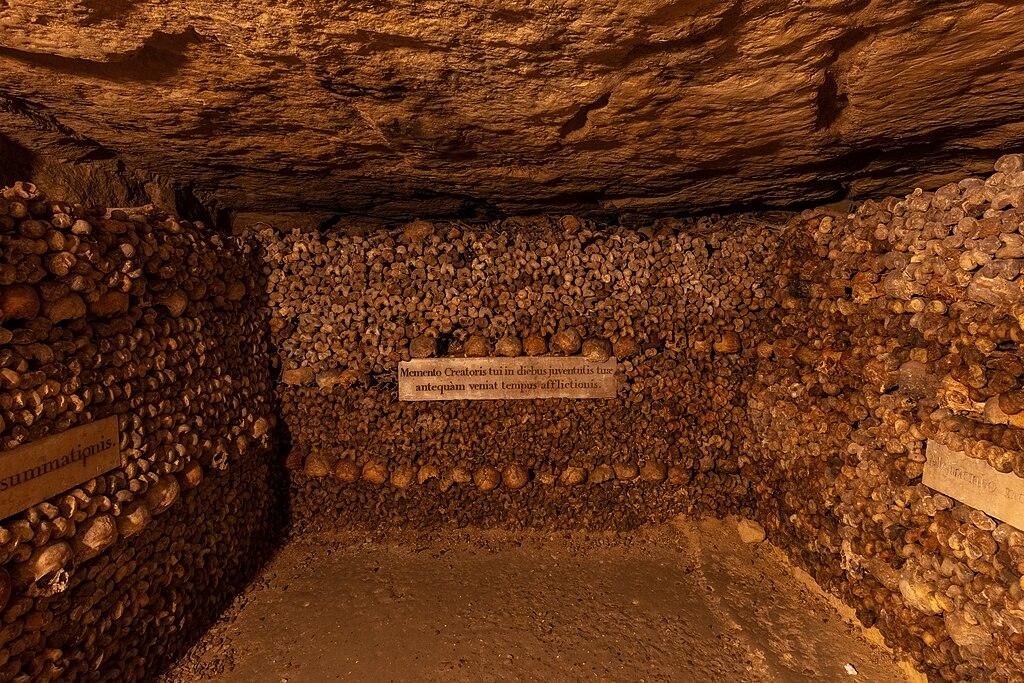
De Parijse Catacomben
You are standing at the entrance on Place Denfert-Rochereau, ready to descend into the Empire of Death – the Paris Catacombs. What was once a network of limestone quarries was transformed in the late 18th century into an ossuary for millions of Parisians. Overcrowded cemeteries, disease outbreaks and collapses made the mass transfer of bones suddenly essential.
Between 1785 and 1814, the remains of around six million people – victims of centuries, plague, revolution and poverty – were moved at night in closed wagons. Under the direction of inspector Guillaumot and later Louis‑Étienne Héricart de Thury, bones were artistically arranged: skulls, femurs, kneecaps, all in symmetrical walls with marble plaques and sculptural gates. From 1809, the Catacombs were open to the public.
You descend 131 steps into a subterranean world of shadow and silence. A black “lifeline” along the ceiling has marked the way out since the 19th century – once a lifesaver for lost visitors. Even public figures like the Count of Artois entered this realm, seeking thrills or novelty.
But the Catacombs are not just monumental – they remain alive. During the Second World War, French Resistance fighters used these corridors as hiding places. Modern “cataphiles” explore the forbidden tunnels, host underground film screenings and consistently lead investigators to new branches.
Any feedback for this story?