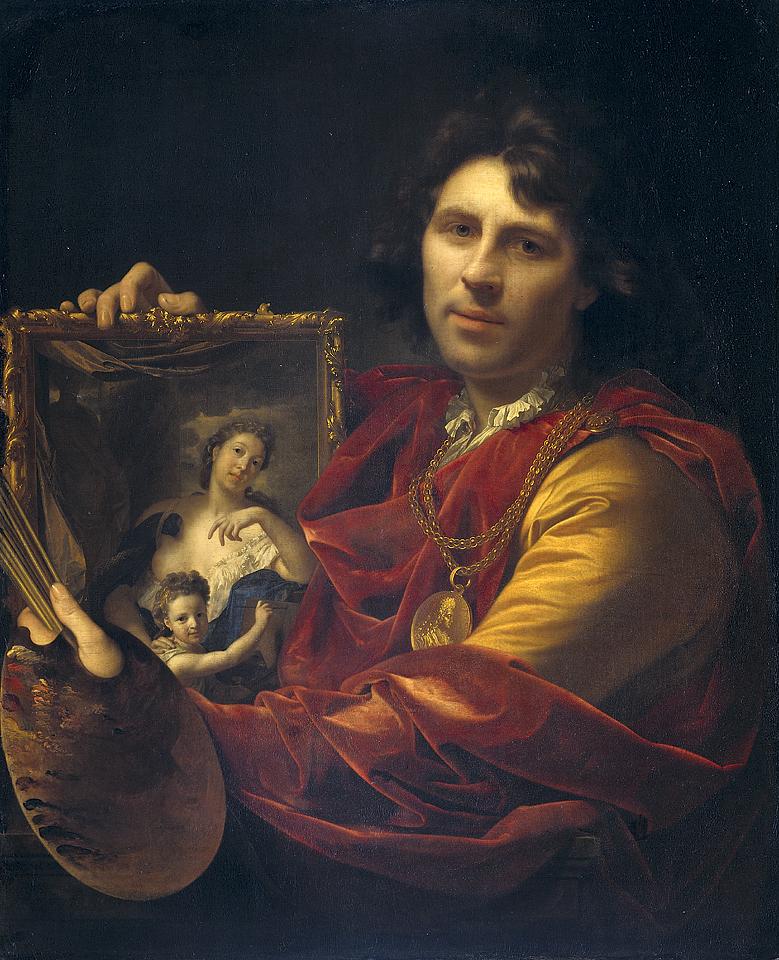
Adriaen van der Werff
The ground beneath your feet holds the memory of a building that once defined this part of Rotterdam. This was the site of the Beursgebouw, a stately merchant exchange on the Blaak, designed by Adriaen van der Werff and lost forever in the bombing of May 1940.
Van der Werff was born in 1659 in nearby Kralingen, the son of a miller. By the age of twelve he was already apprenticed to a master painter, learning a glass-smooth technique that would make his canvases look almost enamelled. His early work focused on portraits and domestic scenes with quiet moral undertones, but after his marriage in 1687 he turned to grand biblical and mythological subjects, and the international art world took notice.
By 1696 he was court painter in Düsseldorf, earning a remarkable salary. In 1703 he was ennobled, and from that point he proudly signed every painting with the word "chevalier." When he died in 1722, the bells of the Laurenskerk rang for four full hours.
His architectural work, including this exchange and several merchant houses nearby, all vanished in 1940. So in a way, Rotterdam lost him twice.
This is the final stop on our tour of Rotterdam's great citizens. And what a way to end it: standing on the ghost of a building designed by a man who was also one of the finest painters of his age. They really did not do things by halves back then.
Any feedback for this story?