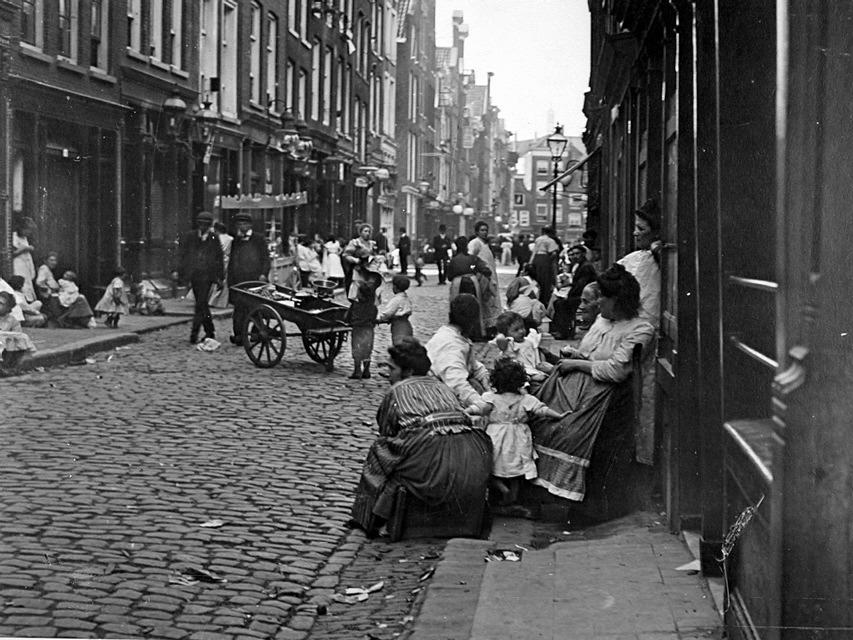
Zandstraat
Here lay the Zandstraat, once the beating heart of a vibrant working-class neighborhood in central Rotterdam.
Between Raamstraat and Leeuwenstraat stretched a maze of narrow alleys and busy streets: Zandstraat, Rode Zand, Kikkersteeg. Around 1900, about 2,500 people lived here, many of them Jewish families. It was a close-knit community with synagogues, cafés, shops, and theaters. The area was known for its energy, but also for overcrowding, poverty, petty crime, and prostitution.
Zandstraat itself was both infamous and beloved. Sailors and laborers found entertainment there, while among the cafés and variety halls, a young Louis Davids grew up. He would go on to become one of the Netherlands' greatest cabaret performers. His songs, often about everyday life and the city, won hearts from Rotterdam to Amsterdam.
In the 19th century, the street became a cradle of Dutch entertainment, but living conditions were dire. In 1909, the city decided to demolish the neighborhood to make way for a grand new city hall on the Coolsingel. Demolition began near Hofplein and was completed in 1940 by the bombing. The street name Zandstraat was officially discontinued in 1936, but reintroduced in 1979 after urban redevelopment.
Today, a sculpture by Mathieu Ficheroux commemorates Louis Davids and the street where his talent first took root.
Any feedback for this story?