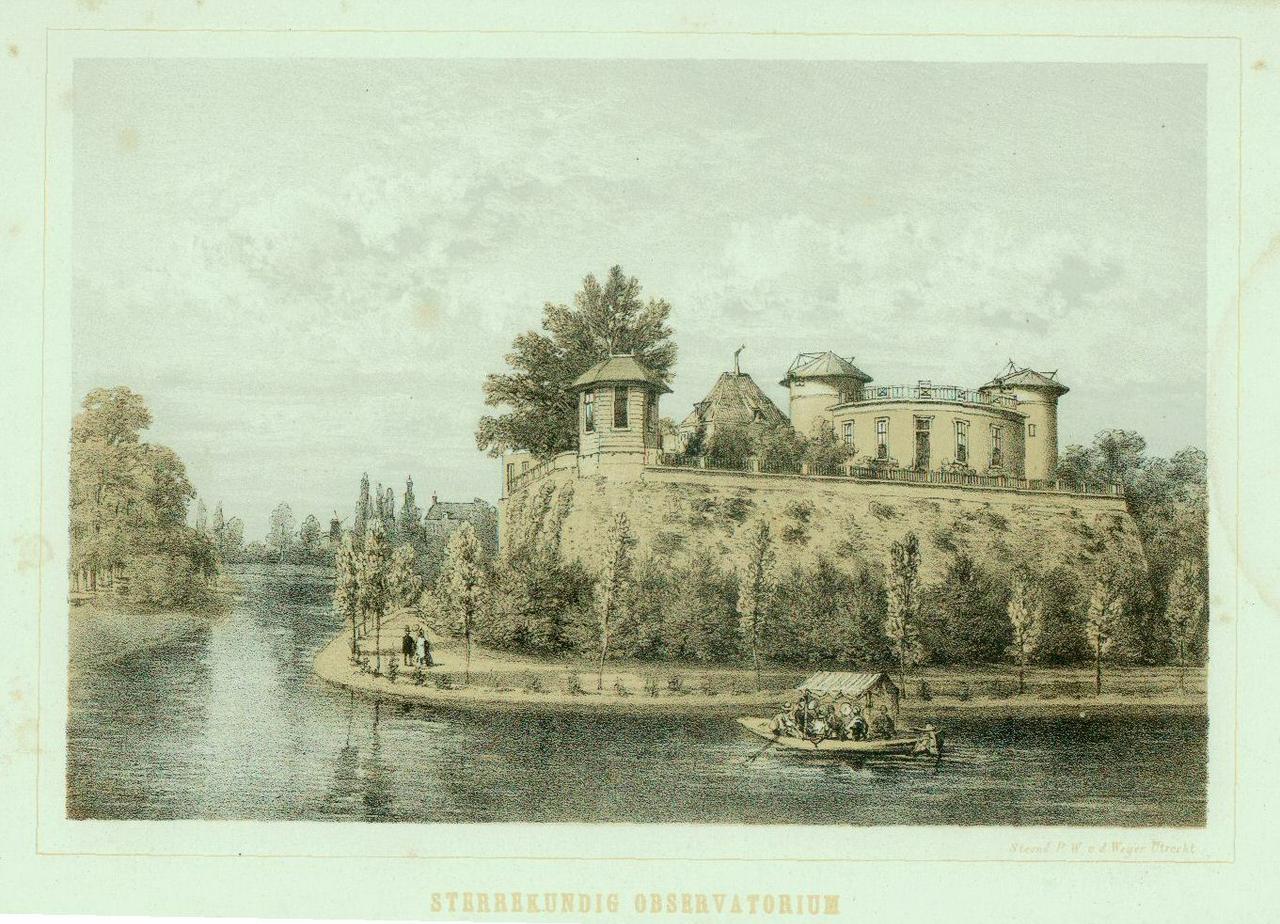
Sonnenborgh
In the sixteenth century, Karel V had a problem. Around 1552, mobile cannons had made medieval city walls completely useless overnight, so Utrecht got four new-style bastions, thick-walled angular fortresses designed to absorb artillery fire. Sonneborgh is the only one that survived almost entirely intact, making it one of the best-preserved bastions in northern Europe. Look at the outer wall and you can still read the Latin inscription carved into the stone: "Fortress of the sun I am called, a hard stone against enemies, a safe place for my own."
Centuries later, the scientist Buys Ballot traveled through Europe and noticed that in Brussels the observatory and the meteorological institute shared the same site. He came home, convinced minister Thorbecke to visit Sonneborgh in person, and walked away with permission to build what would eventually become the KNMI, the Dutch national weather institute, right here on this bastion.
Then, in the nineteen thirties, Marcel Minnaert and Kees de Jager set up a seven-meter telescope and a twelve-meter spectroscope inside these walls and figured out the chemical composition of the sun itself. A fortress built to stop cannonballs ended up producing some of the sharpest observations of a star ninety-three million miles away.
Any feedback for this story?