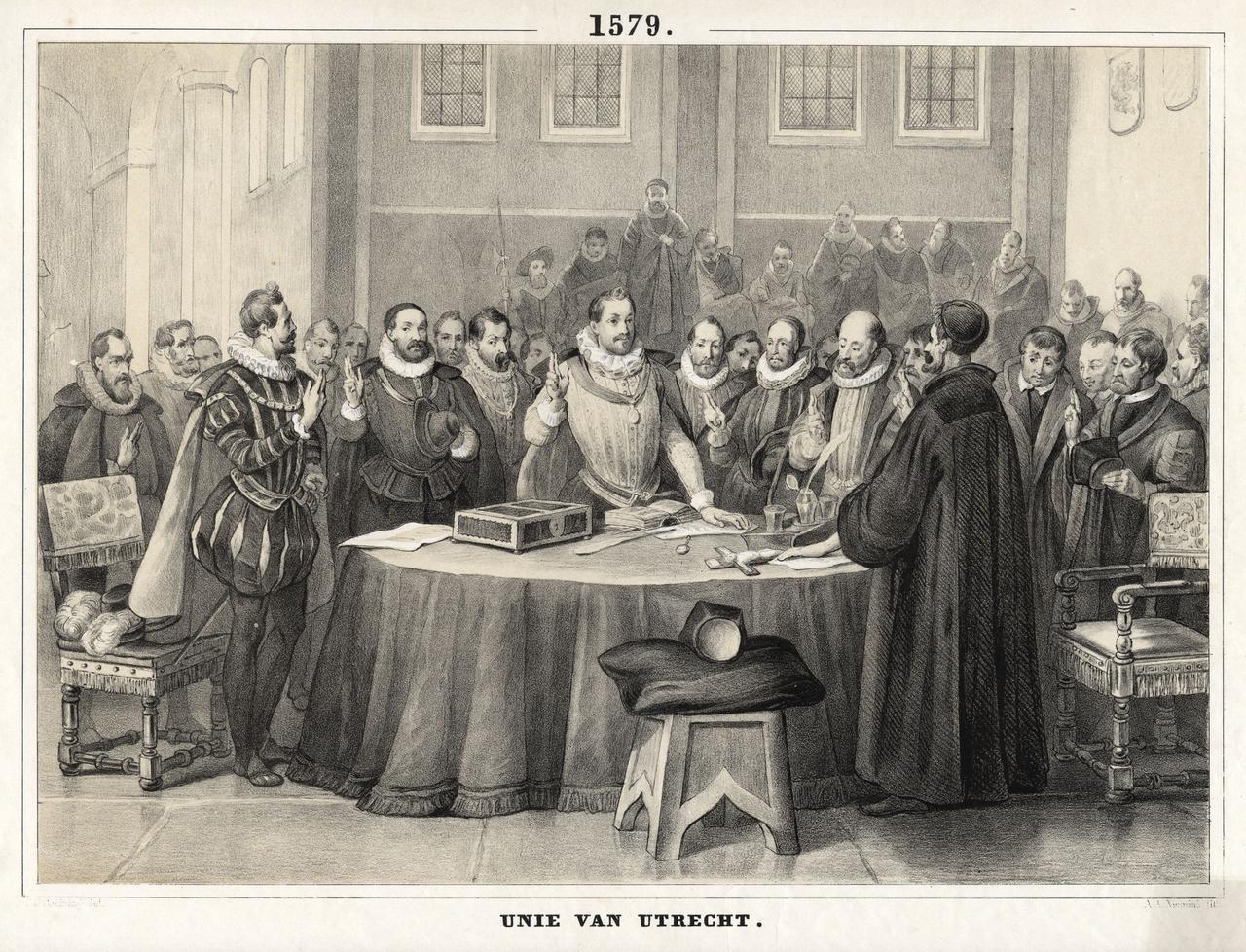
The Union of Utrecht
"On Jan. 29, 1579, the official announcement of the Union of Utrecht took place from Utrecht City Hall. This alliance had come about after months of negotiations between a number of provinces north of the rivers that were fighting against the king of Spain. The Great Chapter Room of the Cathedral served at the time as the meeting hall of the States of Utrecht and now as the University's Aula.
The Union of Utrecht was primarily a military alliance, designed to forge a decisive alliance in the war against the Spanish army. The other members would come to its aid in the event of an attack on one of the Union regions. Although the participating regions each had their own administration, some decisions henceforth had to be made jointly. They were no longer allowed to enter into treaties with other parties alone. Decisions to make war or peace, or to amend the Union Treaty, required general agreement.
The treaty had significant financial implications. To finance the joint defense of the regions, new uniform taxes would be introduced. Currencies would be more unified, and military fortifications had to be well maintained. There was to be a form of conscription for men between the ages of 18 and 60.
The treaty was twofold on the religious front. On the one hand, it adhered to the principle of general religious peace, as expressed in the Pacification of Ghent (1576). Not only Calvinist Holland and Zeeland, but also other regions were now allowed to pursue a different policy if that suited local relations better. The condition was that no one would be persecuted for their religion. This opened the door to a further rise of Calvinism. This development would soon make itself felt in Utrecht as well. Already one year later a total ban on Catholic worship was proclaimed.
To steer the decision-making of the united provinces in the right direction, a new administrative body was established in Utrecht. This body would only exist for a short time, however, because its duties were soon taken over by the States General in The Hague. If disagreements arose, the stadholders of the involved regions would have a mediating role.
The Spanish king was still respected in name by the signatories of the treaty, but its establishment inevitably led to further estrangement. Two years later, in 1581, the Union regions decided to "leave" the king and it came to a final rupture. The States of Utrecht also then put their signatures to the so-called Plakkaat van Verlating."
Any feedback for this story?