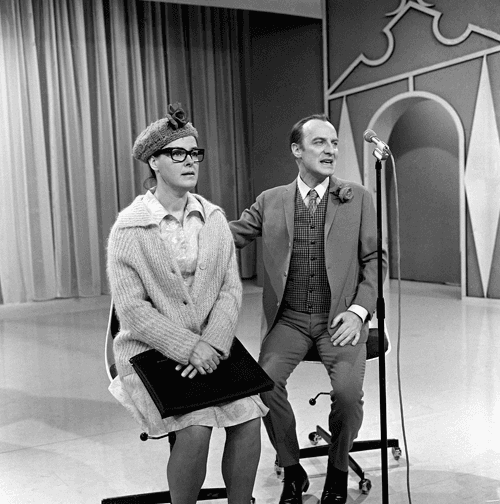
Wim Sonneveld
You are now standing in front of the former home of none other than Willem “Wim” Sonneveld, born on a warm June day in 1917. Wim found refuge and passion in the theater from a very young age, a passion that would ultimately define him as one of the “Big Three of Dutch cabaret,” alongside Wim Kan and Toon Hermans.
Wim grew up in a large family, where he experienced the shadow of grief at an early age due to the loss of his mother. But it was precisely this emptiness that drove him to the place where he felt most at home: the stage. As a little boy, he already stole the show in his father's grocery store. On Saturdays, when the shop was full of customers, Wim would climb onto a box and transform the shop window into his own little theater, singing and acting for anyone who wanted to watch.
Business school proved to be unproductive ground for Wim's talents; his report cards were filled with mediocre grades. His heart lay elsewhere—in cabaret and theater. At the age of nineteen, he founded his own cabaret ensemble, De Rarekiek, which marked the beginning of a career that would no longer require him to take on side jobs. The stages on which he performed became his new home.
His talent and charisma brought him into contact with 'Die Prominenten', a German-Jewish theater group, in the 1940s. Despite the horrors of the war and the subsequent demise of the group, Wim never lost his dream. After liberation, his career blossomed and he founded the Sonneveldcabaret, which would eventually lead him to the legendary De la Mar Theater in Amsterdam.
Wim's personal life was as colorful as his professional life. His relationships with men, although socially challenging at the time, brought him great loves such as Huub Janssen and later Friso Wiegersma. Wiegersma was not only his partner but also his creative companion, writing timeless songs such as “Het Dorp,” which still resonates with many today.
On March 8, 1974, after a life full of applause and standing ovations, Wim died of a heart attack. But his legacy lived on, greater than he could have ever dreamed. Exhibitions, books, and musicals kept his memory alive, allowing new generations to laugh and cry at the stories and songs of Wim Sonneveld. He was more than a cabaret artist; he was an icon of expression, love, and the eternal search for happiness.
Any feedback for this story?