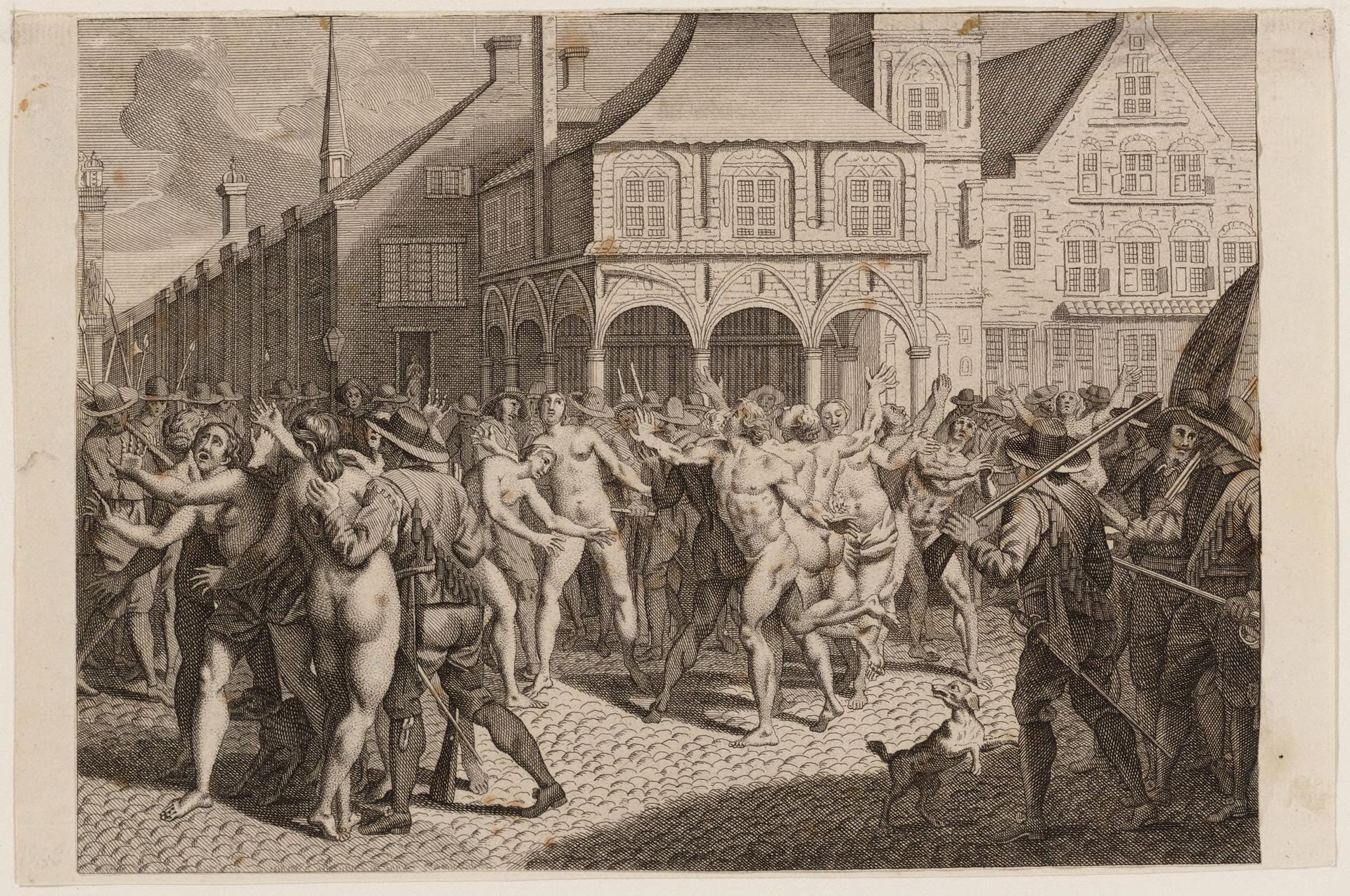
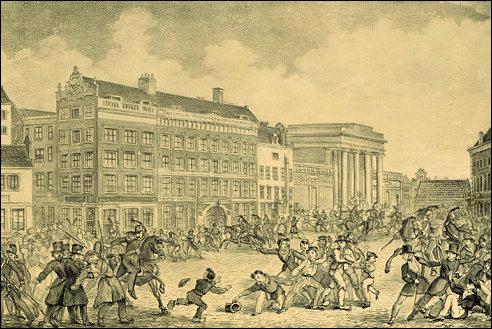
On 24 March 1848, a momentous day in Dutch history, a gathering of workers on Dam Square in Amsterdam came to an exceptionally tumultuous climax that entered the annals as the Glazenmakersoproer. This riot is considered one of the first large-scale workers' uprisings in the Netherlands and took place amid the turbulent atmosphere of the revolutionary year. Remarkably, the police remained in the background. Protesters took to the shopping streets, smashing windows and looting shops. Later, even the windows of patrician houses on the Herengracht and Keizersgracht were not spared vandalism.
The working-class revolution, sparked by Karl Marx and others, did not immediately gain a foothold in the Netherlands. At the time, workers were still poorly organised and lived in harsh conditions. Amsterdam's population was badly affected by the consequences of the economic crisis that had broken out in 1843. Failed harvests and a potato disease exacerbated the crisis, increasing the number of unemployed and increasing hunger, partly due to high excise duties on staple foods such as bread and meat.
1848 marked a turbulent year in Europe, with riots breaking out everywhere. Citizens sought a more liberal system and demanded constitutional reforms. Unrest began in France, where republicans and liberals demanded electoral reforms. Riots also broke out in Berlin in March, known as the March Revolution. King Frederick William IV of Prussia quickly agreed to reforms to calm tempers, including convening members of parliament to review the constitution and promising freedom of the press and reform of the German Confederation. In this context of European uprisings, the Netherlands received a new constitution.
King William II, who ruled in these troubled times, realised as early as 14 March 1848 that change was inevitable. He summoned the Speaker of the House of Representatives to set up a committee to quickly formulate a new Constitution. This committee, headed by Johan Rudolph Thorbecke, produced a draft Constitution within a few months. On 3 November of the same year, the new Dutch Constitution was introduced, marking the beginning of a new era of political and social change in the Netherlands. The Glaziers' Revolt of 1848 and unrest in Europe served as a catalyst for these historic shifts in Dutch society.
Sources. Photos: Our sincere thanks to the Amsterdam City Archives for kindly providing these photographs.