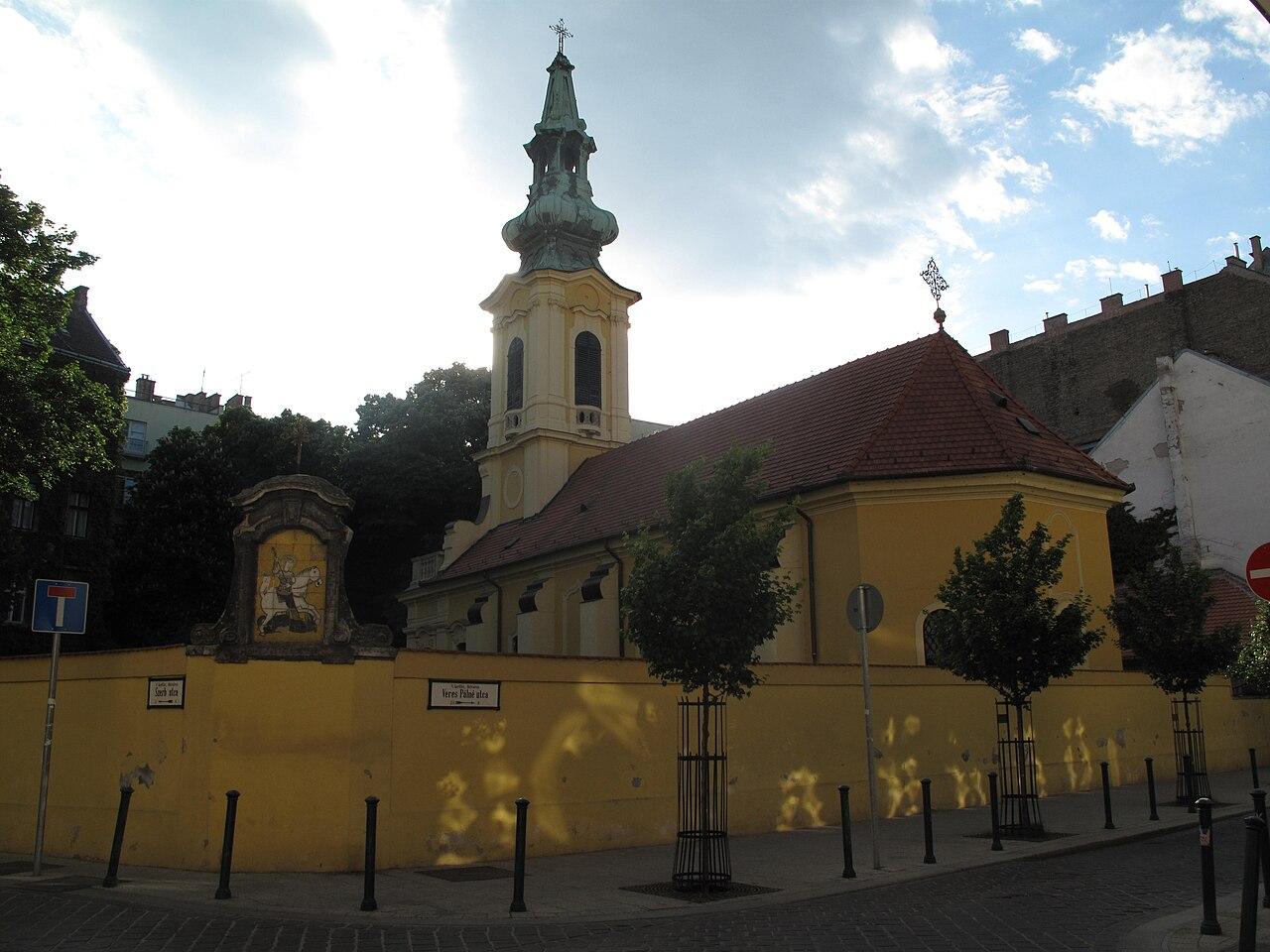
Behind the yellow wall on the corner of Veres Pálné utca there's a garden with a church in it. Stand at the railing and look down. The ground of the garden sits lower than the pavement you're standing on, and that's the old street level of , from before the city raised the streets here in the 1930s.
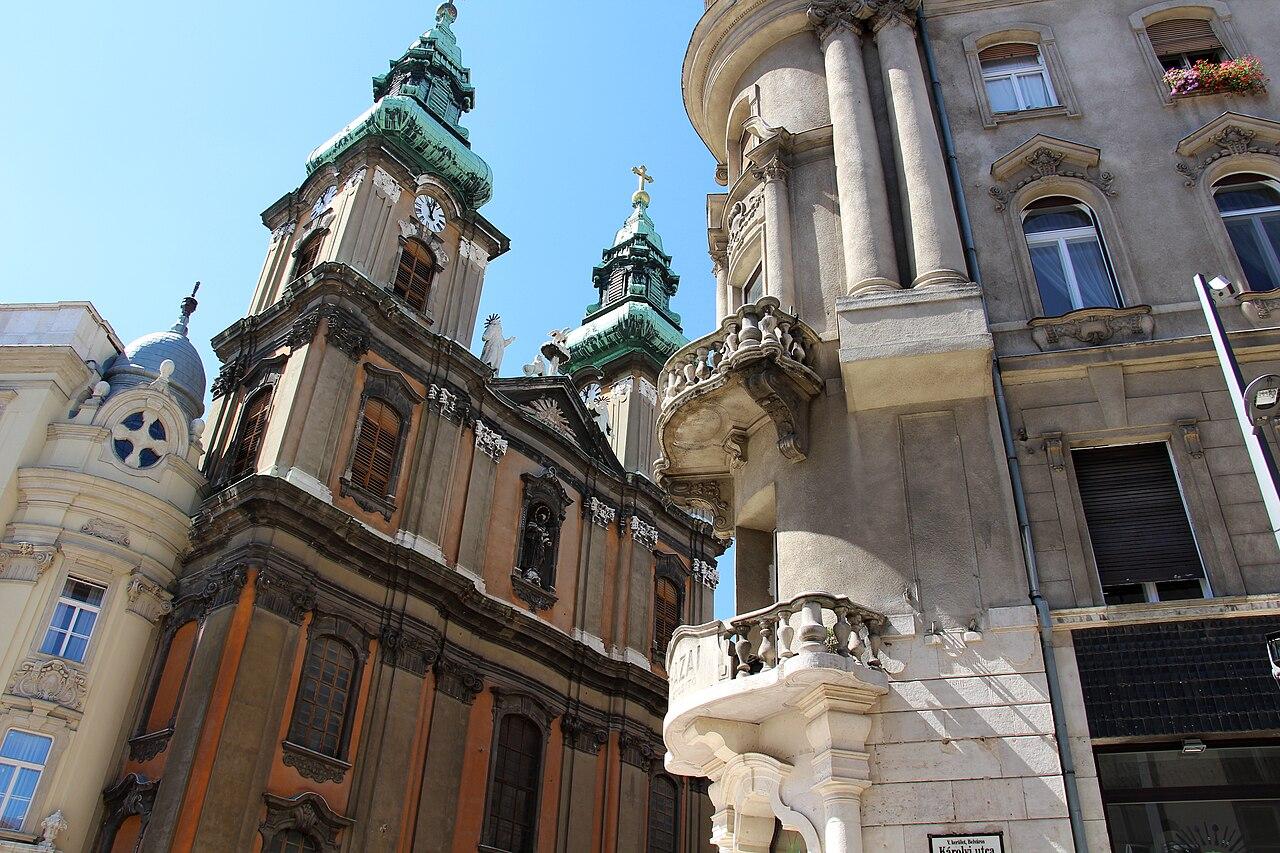
This is the church of Saint George. Serbs fleeing the ended up within the walls of Pest, and in the eighteenth century seven to nine hundred of them lived around this corner, on Szerb utca, Veres Pálné utca and the streets behind them. First they repaired the church that already stood here and dedicated it to Saint George in 1698. From 1733 onwards they built the church you see now, to a design by András Mayerhoffer, the same master builder who created the Pauline church on Egyetem tér. The bell tower and the front façade were finished in 1752.
Against the inside of the wall stand gravestones of Serbs buried in Pest, carrying dates from the eighteenth and nineteenth centuries. In the niche on the corner there's a ceramic Saint George with his dragon, and the ornamental railing on Szerb utca dates from 1776. The church itself mostly opens for services, so the garden is usually what you get to see of it.
We follow Szerb utca out to Váci utca and head north, until the square by the river opens up.
Sources. Story: hu.wikipedia (Szerb templom, Budapest) over de bouw tussen 1695 en 1698 op middeleeuwse fundamenten, de nieuwbouw vanaf 1733 naar ontwerp van Mayerhoffer András, de klokkentoren van 1752, het sierhek uit 1776 en de ophoging van de straat in 1932; Pestbuda.hu over de wijding aan Szent György en de inrichting van het interieur; HG.hu over de Servische gemeenschap binnen de stadsmuren van Pest en hun aantal in de achttiende eeuw; Ittjartam.hu over de grafstenen langs de tuinmuur, de keramieken Sint-Joris in de hoeknis en het oorspronkelijke straatniveau in de tuin Photos: Church: Dezidor, CC BY 3.0, via Wikimedia Commons. Gravestone: Globetrotter19, CC BY-SA 4.0, via Wikimedia Commons