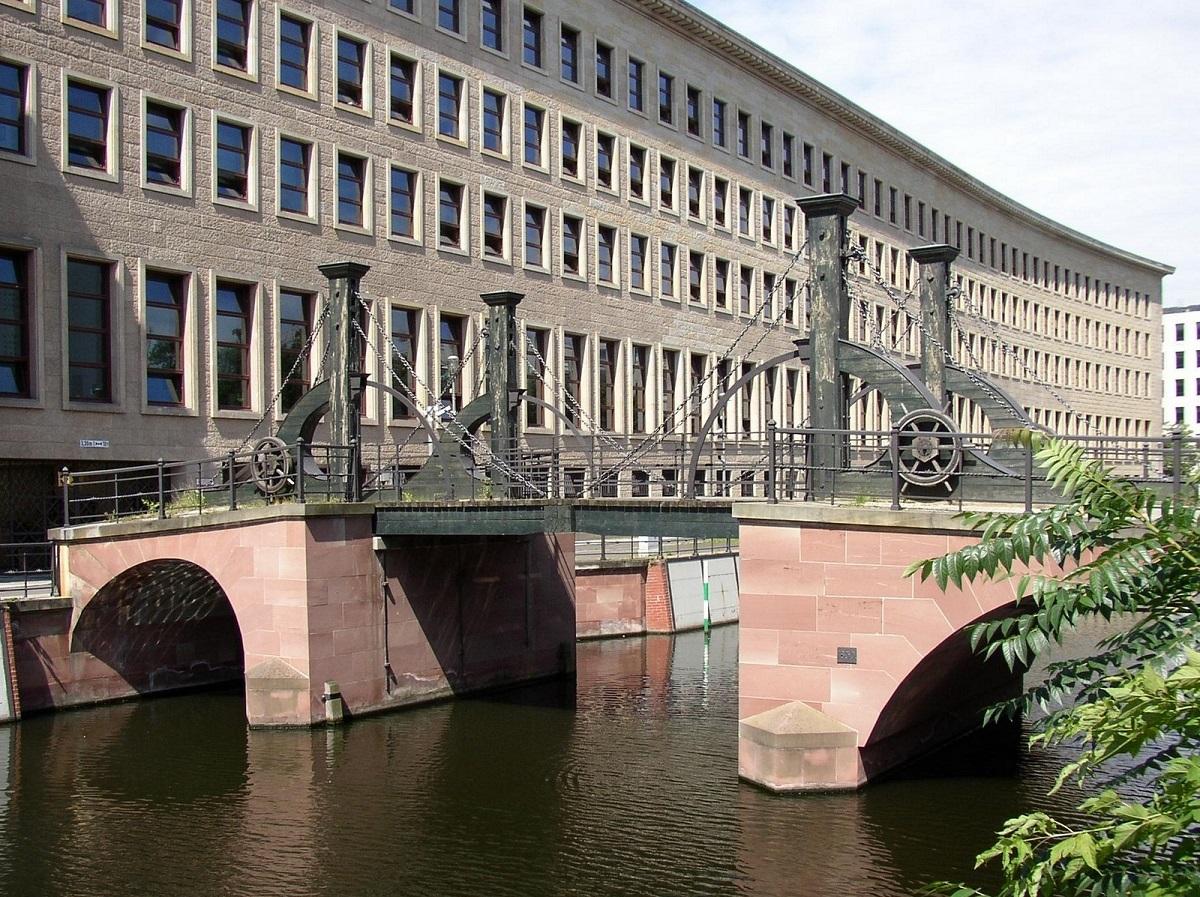
You are standing on the Jungfernbrücke, Berlin’s oldest surviving bridge, largely unchanged since its construction in 1798. This distinctive wooden-and-iron bascule bridge spans the Kupfergraben arm of the Spree, linking Friedrichsgracht with Unterwasserstraße. Originally, nine identical drawbridges stood here — this is the only one remaining. Around 1688 or 1689, under Elector Frederick III, a wooden footbridge was first erected. The name “Jungfernbrücke” appears in records by 1690, though numerous local legends try to explain it — from gossiping unmarried daughters of a Huguenot family to a tragic murder allegedly committed on the bridge.
In 1798, master builder Friedrich Becherer replaced the original with an iron-and-wood drawbridge. Until the 1930s, the central span could be raised for ships using chains and winches. During late-1930s renovations, the mechanism was permanently disabled, piers were extended, and a fixed steel surface replaced the movable parts. A wooden plank deck remained for pedestrians only.
Sources. Story: Source Story: ['Source Story: https://en.wikipedia.org/wiki/Jungfern_Bridge', 'Source Story: https://de.wikipedia.org/wiki/Jungfernbrücke_(Berlin)', 'Source Story: https://www.berlin‑lese.de/streifzuege/sagen-und‑märchen/die‑jungfernbruecke/', 'Source Story: https://fromplacetoplace.travel/germany/berlin/jungfernbruecke/', 'Source Story: https://berlingeschichte.de/lexikon/mitte/j/jungfernbruecke.htm'] Sources Photos: Source Photo: https://upload.wikimedia.org/wikipedia/commons/c/cb/Berlin_Jungfernbruecke_S.jpg I, DorisAntony, CC BY-SA 3.0 <http://creativecommons.org/licenses/by-sa/3.0/>, via Wikimedia Commons