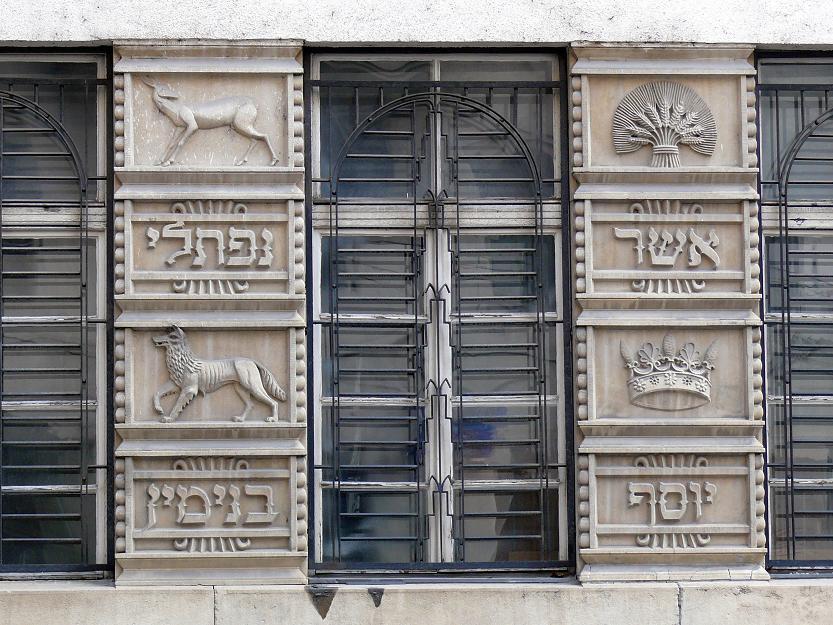
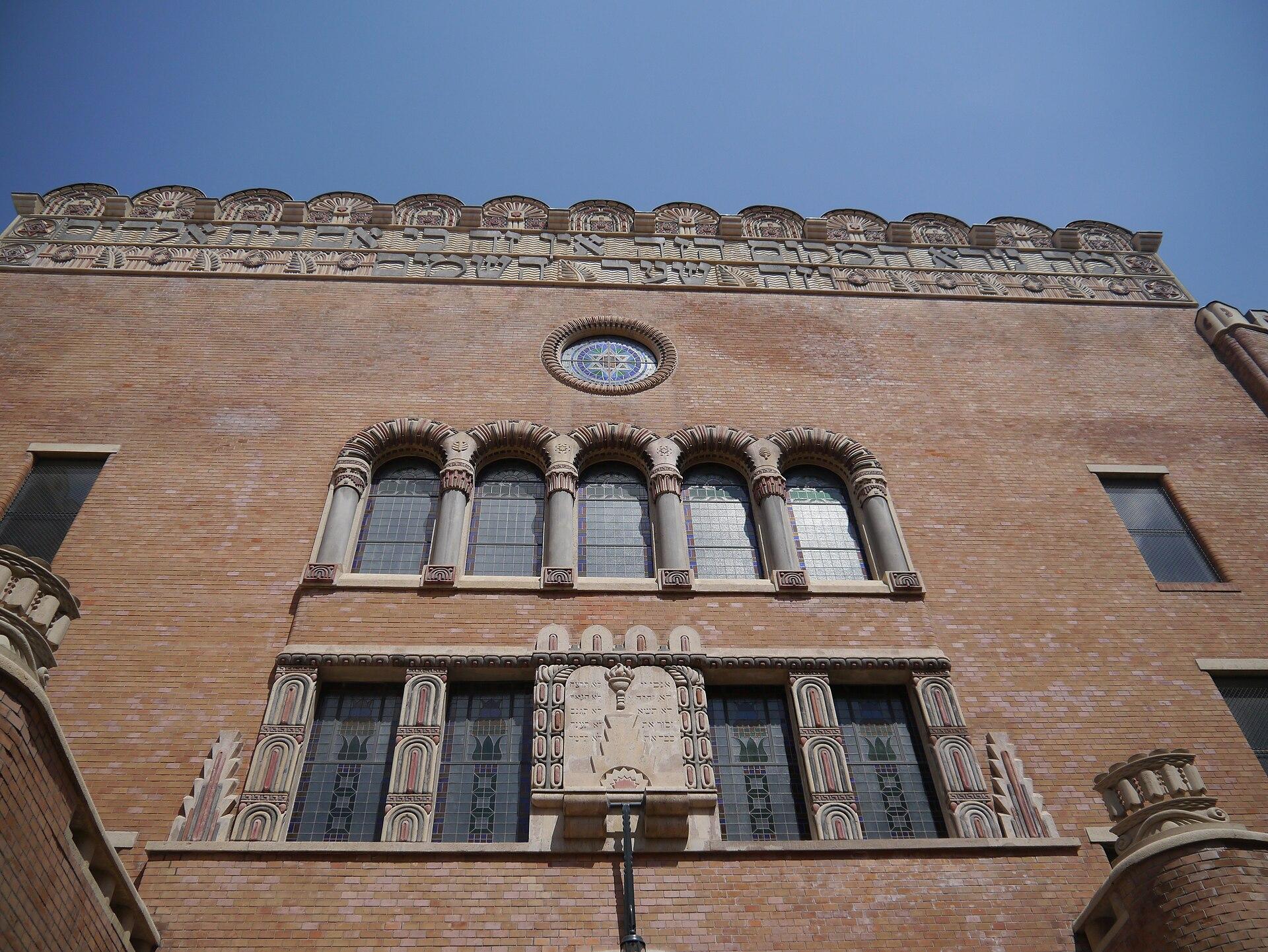
The street bends here, so you only really see this building once you're almost standing in front of it. Red brick, side wings that climb upward in terraces, and Hebrew letters running across the whole width. It's the only synagogue in the country built in the .
It belongs to the third branch of the split you already came across at the . The went without a home of its own the longest, and only finished in 1913, the last of the three.
The competition didn't go as planned. The jury picked the design by Porgesz and Skultetzky, and then in May the community set that verdict aside and hired the Löffler brothers instead, Sándor and Béla, who had worked earlier under the architect . Six hundred and fifty thousand crowns had been set aside for the construction.
The work dragged on and the money ran out faster than expected. So in July 1913 the brothers submitted a change for a plainer front, using less material. What you're looking at now is the version they could still afford. Inside, though, they held on to the lavish work, with stained glass windows by .
And it isn't just one building. Behind it sit a school, a Talmud school, a kindergarten, an office, a kitchen and a slaughterhouse, and twenty metres away across the street lies the only ritual bath in the city. We walk on to Kazinczy utca 14.
Sources. Story: Kitervezte.hu and Guide@Hand, on the competition, the budget and the altered facade of 1913; We Love Budapest and Budapest Info, on the Secession style, the windows by Miksa Róth and the parts of the complex. Photos: Facade: Zairon, CC BY-SA 3.0, via Wikimedia Commons. Relief supplies 1946: FOTO:FORTEPAN / Hámori Gyula, CC BY-SA 3.0, via Wikimedia Commons.