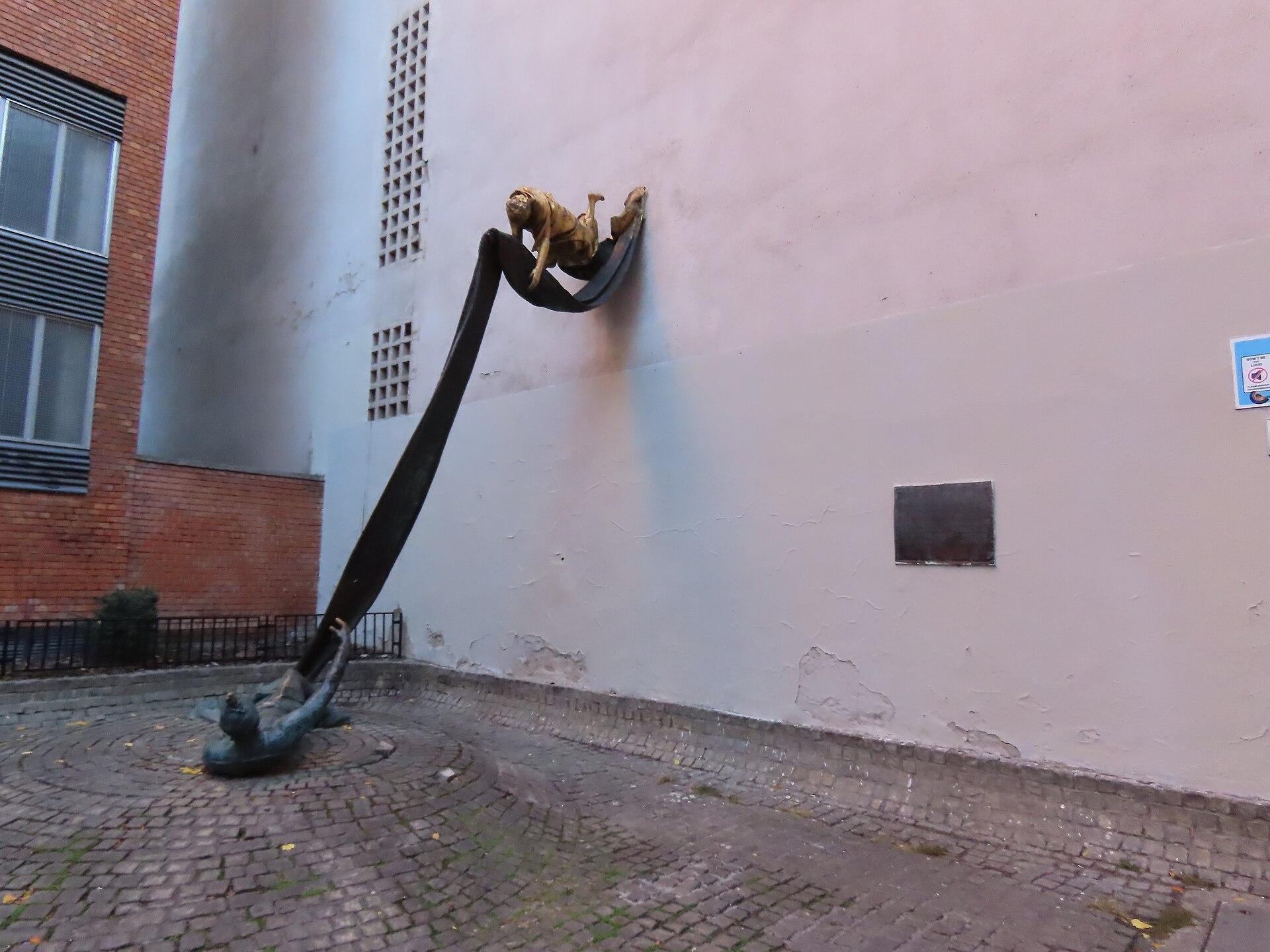
From the wall in front of you, a gilded angel dives down toward a figure lying on the pavement. Below it is a line from the : whoever saves one life saves the whole world.
The statue stands on this corner because one of the entrances to the was nearby, just a few steps from the boundary you came across back on Király utca. It was put up in 1991, sixteen years after the death of the man it honours, paid for by a collection in Switzerland and made by the sculptor Tamás Szabó with the architect Ipoly Farkas.
Carl Lutz was the Swiss vice-consul in Budapest from 1942 to 1945. He issued protective letters that placed people on a collective passport, and he had seventy-six houses in the city placed under Swiss protection. The most famous of these is the Glass House on Vadász utca, where three thousand people found shelter. According to a statement by his wife Gertrude, he and his staff saved more than sixty thousand people this way. and the Red Cross took up his method.
In his diary he wrote that it was driving him mad to keep having to choose who he saved, and he asked himself where God was. He died in 1975 in Bern. Recognition in his own country came late. We walk now to Síp utca.
Sources. Story: Haver Alapítvány, on the monument, the Talmud quote, the seventy-six protected houses and the Glass House; Köztérkép, on the unveiling on 5 July 1991 and the Swiss collection; Center for Jewish Art, on its placement by one of the entrances to the ghetto and the origin of the quote from Mishnah Sanhedrin 4:5. Photos: Wikimedia user יעקב, CC0, via Wikimedia Commons.