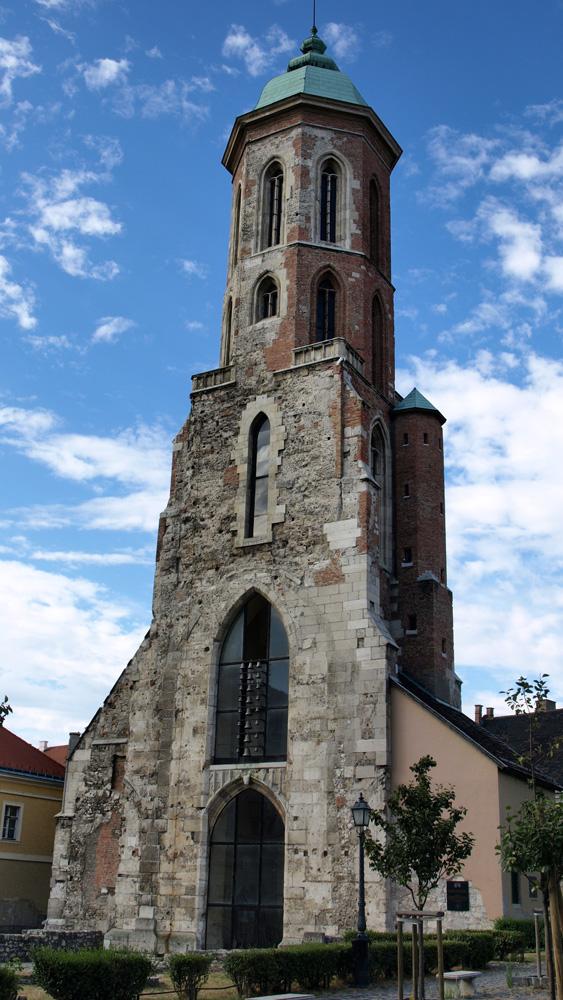
This tower stands alone, because the church attached to it was never rebuilt after the war. It was torn down instead.
For centuries, two communities lived side by side on this hill. , belonged to the German-speaking townspeople, who ran the government and the trade. The Hungarian-speaking residents came here. When the took in the sixteenth century and stayed for a century and a half, this was the only church Christians were still allowed to use, until it too was turned into a mosque.
During the , the building took several bomb hits and the tower cracked. It was still standing, and by 1946 an architect already had a repair plan ready, after which the roof and part of the choir wall were rebuilt. Then in 1950 came the order to demolish the church after all, reportedly from himself, the communist leader who ran Hungary at the time. Only the tower was left.
Over the next two years, that tower was made more Gothic than it had ever actually been. The Baroque windows it had before the war were replaced with pointed arches. So what you're looking at is a medieval tower that was dreamed up in the nineteen fifties.
The outline of everything that was demolished is set into the paving around you, so right now you're standing inside the floor plan of a church that no longer exists.
We carry on to the gate at the northern end of the district.
Sources. Story: Wikipedia, Mary Magdalene Church (Buda), on the demolition in 1950 and the restoration of the tower between 1950 and 1952; Nagyon Var, on the two communities and their churches in the Castle District Photos: Misibacsi, CC BY-SA 3.0, via Wikimedia Commons