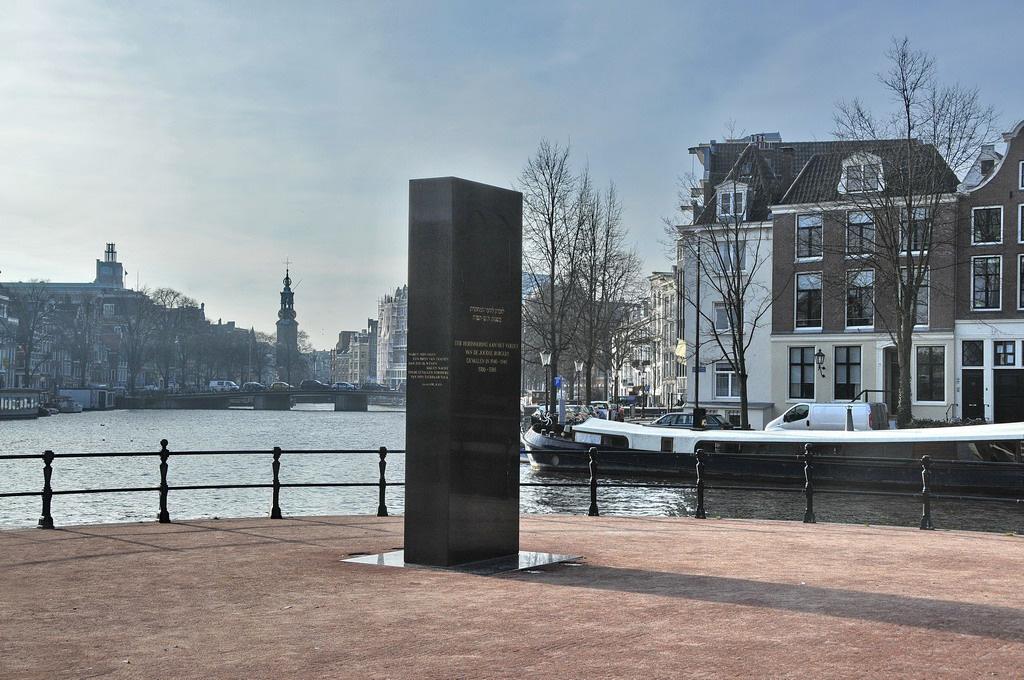
On the quay where the Zwanenburgwal meets the Amstel stands a black granite column, keeping itself small beside the , the building that houses the city hall and the opera together. On top lie two stone tablets carrying the same words in Hebrew and in Dutch: in memory of the resistance of the Jewish citizens who fell in 1940-1945. Beside those years the same span appears once more as 5700-5705, the way it is counted in the .
The shape comes straight out of a craft. Joseph Glatt, who made the monument in 1988, was a stonemason in the village of Putte in the south of the Netherlands, and he had built his trade on Jewish gravestones, which the column still shows.
The initiative came from Jewish resistance members themselves. Post-war accounts of the occupation long left their share in the shadows, while Jewish residents of Amsterdam took part in acts such as the in 1943, for which the student Rudi Bloemgarten was executed by firing squad later that year.
The ground beneath the monument has a history of its own. This was , for centuries the heart of Jewish Amsterdam, demolished after the war to make room for the city hall and the opera house behind you.
Sources. Story: Boekmanstichting, Oorlogsmonumenten in Amsterdam, Boekmancahier 17, boekman.nl. The Historical Marker Database, Joods Verzetsmonument, hmdb.org.