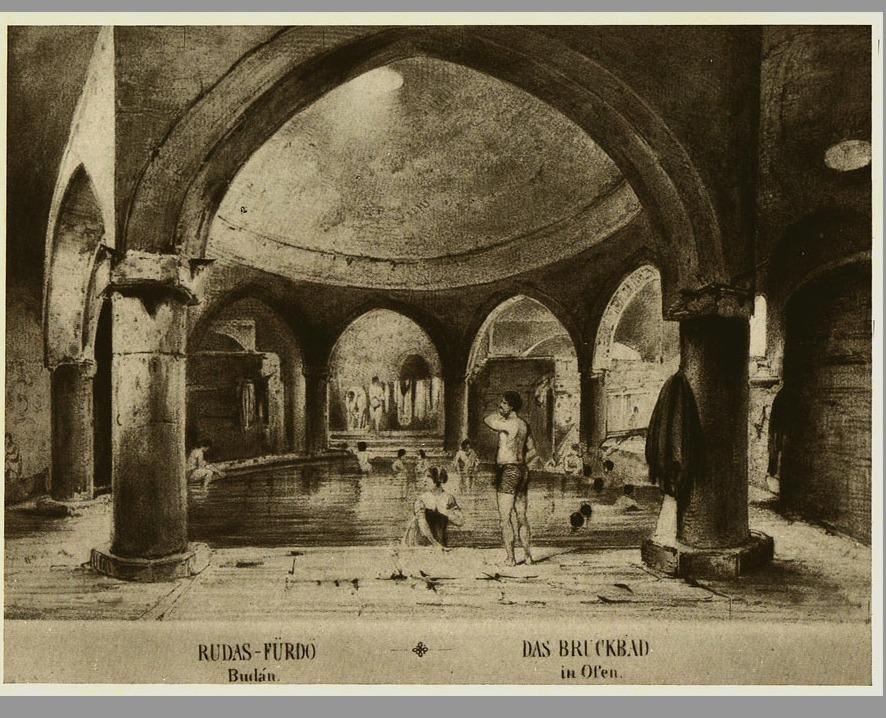
Behind this plain façade lies a space more than four hundred and fifty years old where people still sit in the water every day. At its centre is an octagonal pool under a dome ten metres across, carried on eight columns, with small openings in the dome where the light falls in streaks through the steam.
Long before the arrived, the already had a hospital with a bathhouse here, because the warm water rises from the ground on this spot all by itself. , the most powerful ever knew, had it rebuilt between 1566 and 1572 in the form you still see today. The Turks called it the bath with the green column, after a column no one has ever found again, though there are green stones set into the walls. The name Rudas probably comes from the Serbs and Bosnians in the neighbourhood next door, who called it their mineral bath.
Since then there has barely been a single year it closed its doors. From 1936 this pool was reserved for men on almost every day, who went in wearing a cotton apron tied around them, and that is where its Hungarian nickname comes from: the apron bath.
We follow the road further north, towards the steps and arches set against the slope of the palace.

Sources. Story: Magyar Nemzeti Levéltár, A Rudas fürdő első dunai szárnya, on the construction by Sokollu Mustafa and the older bathing history of the site; We Love Budapest, Történelmi fürdő a város közepén, on the dome, the name and the apron bath. Photos: Rudas-fürdő, print between 1910 and 1915, public domain via Wikimedia Commons.